Co-working space | Customer Journey Map (AI-Augmented)

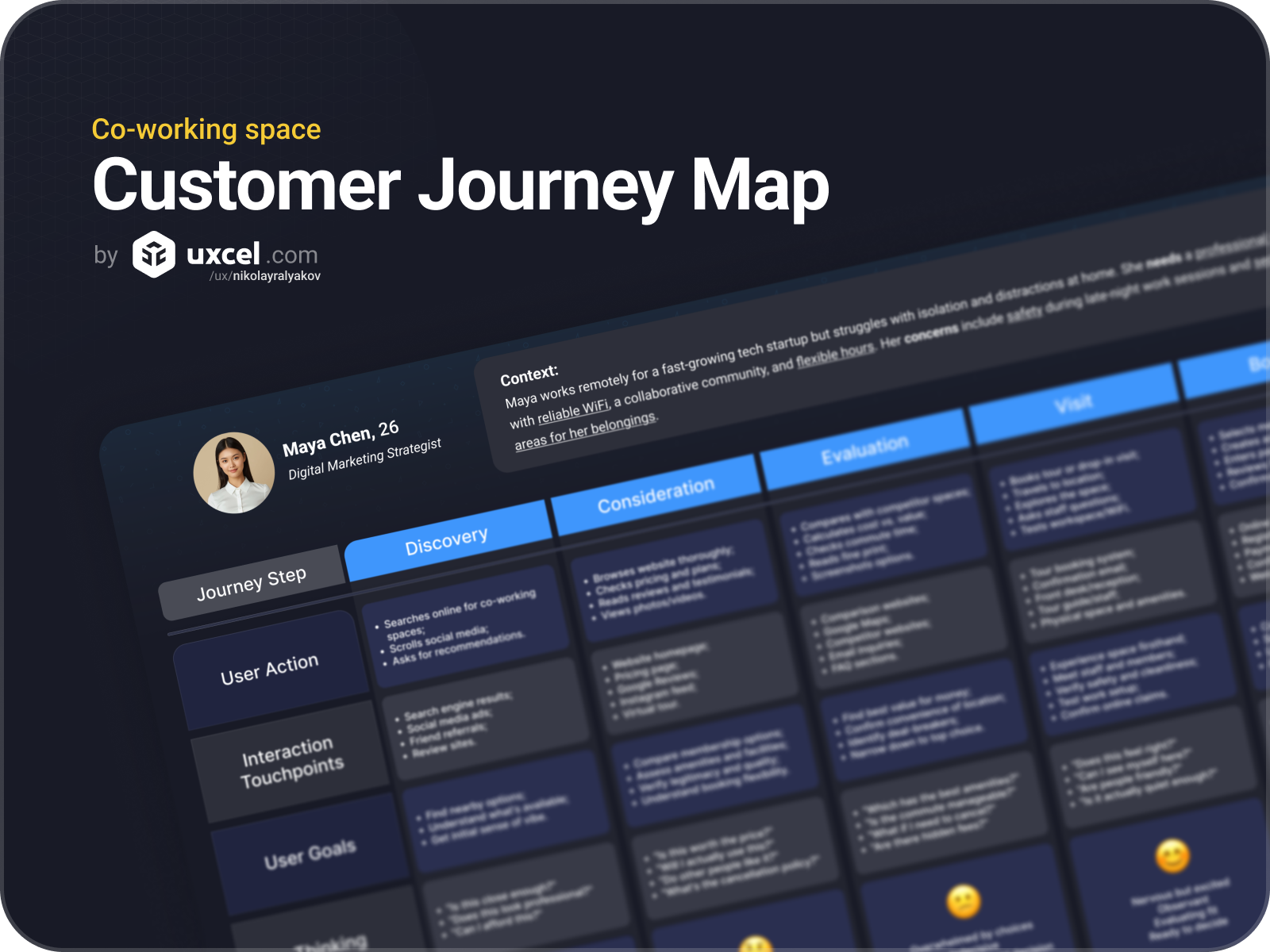
Brief Description
I chose to not select a specific company to create the CJM around, but rather the general idea set forth in the brief. I used Claude's Sonnet 4.5 model to generate a majority of the information used in the Customer Journey Map.
*All assets used in the brief, including, but not limited to, the persona, headshot, and journey steps, are fictional and not the direct reflection of an actual individual.
Persona
To keep in line with the brief's objective, I jotted down my interpretation of what a user of such service would look like, and prompted Claude with the following (after providing task context):
"I need a Gen Z female user persona, working in a high-pace environment remotely, that, in the span of a few concise sentences, explains the context under which she is looking for a co-working space, including motivations, goals, and potential areas of concern (such as safety)."
In response to which, after further refinement, he provided me with the persona and context used in the CJM. To generate the image, I used Leonardo's Lucid Original model.
Journey Steps
I needed to generate a set of journey steps that led to a definitive conclusion of the journey being mapped out, for the purpose of which I used the following prompt:
"The objective of the customer journey map is to identify pain points and opportunities for improvement, to enhance the overall experience, including the online experience, for individuals utilizing co-working facilities.
Generate broad key step of the customer journey that lead to a booking."
Layer Selection
There was no complex rationale used to generate the CJM layers. I considered the most basic layers that would contribute to a comprehensive (yet brief) CJM, and put them on the map.
Journey Information
The information in the journey under each step for each layer was generated by Claude as well. I used the following prompt, which I repeated for every layer of the journey:
"Generate brief few-word points for Discovery, for the following layers:"
Claude already had the context of the task at hand, the persona, and the desired information, so it was pretty straightforward from there.
Conclusion
While CJMs are deeply rooted in rationale and reasoning, I used AI to assist me in crafting this one for the brief, as it's supposed to serve as a general journey map, without going into any specifics (ergo, the lack of KPIs and metrics).
Of course, with more specific data, and for more specific scenarios, it'd be easier to craft a CJM that is a true reflection of the user and their journey, while potentiating the highest potential for valuable insights.
Tools used
From brief

Topics
Share
Reviews
4 reviews

Looking at this CJM, visually it makes a solid impression. Clear hierarchy, cohesive dark mode aesthetic, and sensible layer selection. The emojis in the "Feeling" section are a simple but effective way to quickly scan user emotions. 😊👍
However, the content is very generic, which the author themselves admits in the brief. Points like "confusing pricing structures" or "too many form fields" are classic pain points that fit almost any SaaS. There's a lack of insight stemming from real research.
I understand the brief's premise (general map without a specific company), but in practice such a CJM has limited decision-making value. Without qualitative or quantitative data, it's hard to prioritize what actually needs fixing. It's more of a template than an actionable tool.
What makes me wonder... The "Opportunities" section also sounds like wishful thinking, not conclusions from analysis. "Video testimonials from Gen Z members" - how do we know that'll work? 🤔
Despite these remarks, as a workshop exercise and demonstration of an AI-assisted process. It's perfectly fine. The foundation is there, now it's worth filling it with real data and validating assumptions with actual users. The potential is there! 💪😊❤️

Excellent work, Nikolay! Your transparency about using AI is refreshing. Your visual execution is strong. Here's my feedback:
Strengths:
- Transparency: You clearly explain your AI-assisted process and acknowledge the lack of real research
- Visual execution: Clear hierarchy, cohesive dark mode, sensible layers. Easy to scan
- Emotional layer: Emojis in the "Feeling" section effectively show the emotional journey
- Structured approach: You show prompts and reasoning, demonstrating intentional methodology
- Persona development: Realistic Gen Z persona with clear context (remote work, safety concerns)
Critical Gaps (Flagged by Mentors):
- Generic Content — Pain points such as "confusing pricing" or "too many form fields" apply to almost any SaaS. This lacks specificity. Real research reveals unique, actionable insights.
- No Validation — Opportunities read like wishful thinking ("Video testimonials from Gen Z"). How do you know this works? Assumptions need evidence.
- Missing KPIs & Metrics — Which opportunities have the highest ROI? What metrics improve? This transforms the template into a strategic tool.
- Limited Decision-Making Value — Without qualitative or quantitative data, prioritization is impossible. This is more of a template than an actionable tool.
- No Real Research — Interview data, user testing, or competitive analysis would ground this in reality. An AI-generated journey is plausible but unvalidated.
Key Questions:
- Did you interview actual co-working space users?
- What does competitive analysis reveal?
- How would you measure success for each opportunity?
- What's the business context (target segment, pricing)?
Overall: Strong visual and structural thinking. Solid foundation. Now ground it in reality: conduct user research, validate assumptions, add KPIs, prioritize by impact.
Next: Add real research, validate assumptions, document KPIs, prioritize by business impact. You're at 50% of a strategic CJM.

Hey Nikolay!
I just went through your Co-Working Space Customer Journey Map (AI-Augmented) project and I really like how structured and intentional it feels.
You did a great job breaking down the journey into clear stages it’s easy to follow the user’s emotional shifts, pain points, and opportunities across the experience. I especially appreciate how you layered AI augmentation into the journey instead of forcing it in. It feels contextual and tied to real friction points, not just “AI for the sake of AI.”
One thing you could push further is adding more measurable impact. For example, what KPIs would improve if those AI interventions were implemented? That would strengthen the strategic layer and show business thinking on top of UX thinking.
Overall, this feels thoughtful, well-organized, and product-minded. Strong work especially in how you connect user emotions with solution opportunities 👏

Overall, the project looks very solid and well executed. Great work.
You might also like

Smartwatch Design for Messenger App


Bridge: UI/UX Rebrand of a Blockchain SCM Product


Pulse Music App - Light/Dark Mode


Monetization Strategy


Designing A Better Co-Working Experience Through CJM


Design a Settings Page for Mobile
User Research Courses

Ethical & Responsible Product Design


Product Management Foundations


The Product Development Lifecycle & Methodologies