Using the Product Strategy to Defining OKRs
Discover ways to turn strategic priorities into measurable goals that align teams and drive focused execution
OKRs (objectives and key results) serve as the bridge between strategic vision and measurable outcomes. When strategy and OKRs work together, teams gain clarity on what matters most and how to track progress toward meaningful goals. Effective OKRs translate strategic choices into specific, time-bound commitments. Rather than generic goals like "improve user experience," strategy-driven OKRs articulate explicit choices that narrow the team's focus and guide prioritization. This connection ensures every objective traces back to a strategic rationale, and every key result measures progress toward strategic outcomes.
The relationship between strategy and OKRs flows both ways. Strategy informs the objectives teams pursue, while OKR progress provides feedback on whether strategic bets are paying off. This creates a continuous cycle of planning, execution, and learning that keeps teams aligned with broader product goals while remaining responsive to new insights and changing conditions.
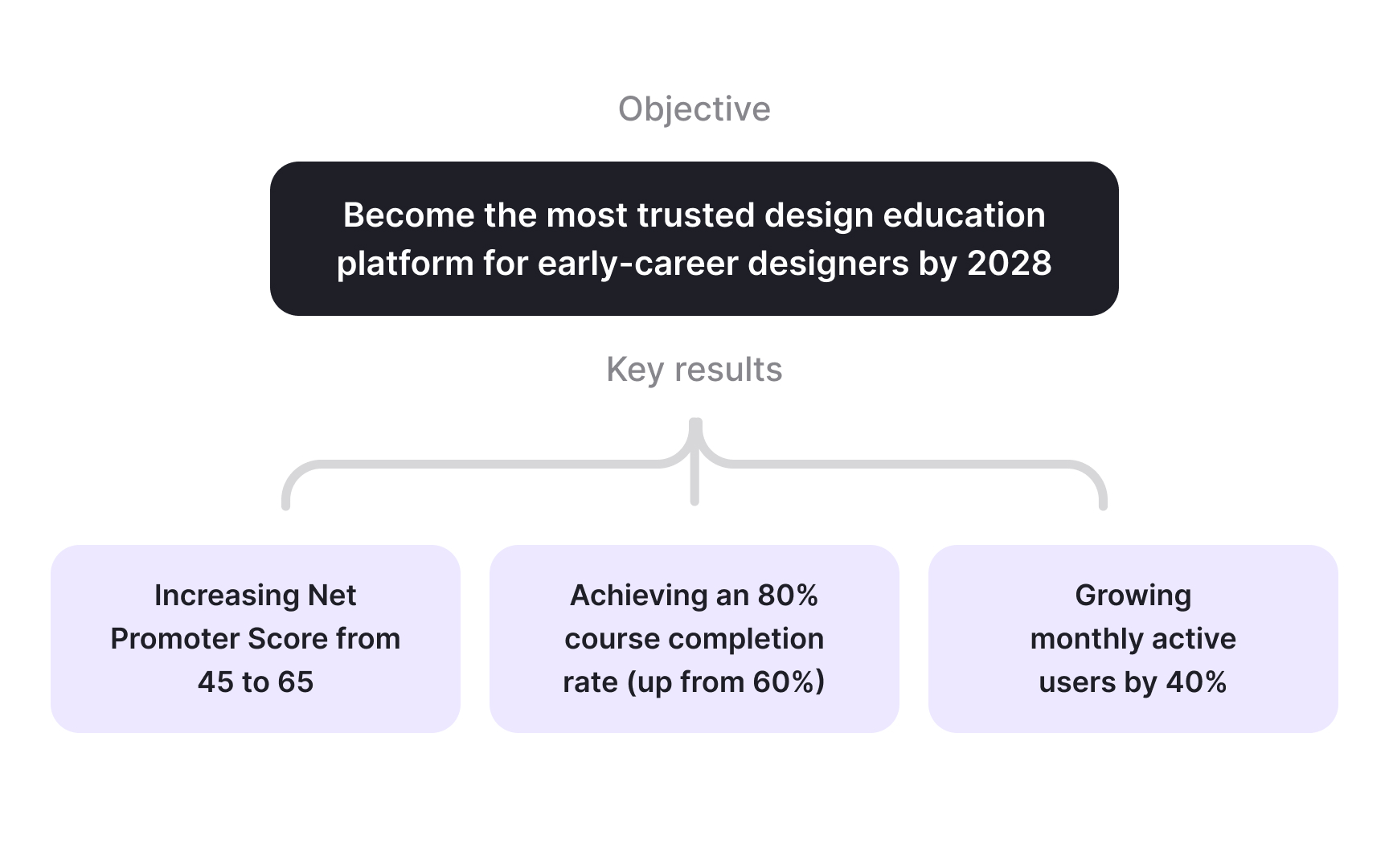
OKRs stand for objectives and key results. They provide a goal-setting framework that helps teams define what they want to achieve and how they will measure success.
An objective describes a qualitative goal you want to reach. It should be ambitious, inspiring, and time-bound. Good objectives answer the question "Where do we want to go?" and create alignment around a shared direction. Key results are the quantitative measures that track progress toward the objective. They answer "How will we know we're getting there?" Each objective typically has 2-4 key results that are specific, measurable, and have clear success criteria. For example, consider an objective like "Become the most trusted design education platform for early-career designers by 2028." This objective could be measured through key results such as increasing Net Promoter Score from 45 to 65, achieving an 80% course completion rate (up from 60%), and growing monthly active users by 40%.
OKRs work best when they're transparent across the organization, allowing teams to see how their work connects to company-wide priorities. This visibility helps coordinate efforts and prevents teams from working at cross-purposes.[1]
Product strategy defines the choices you make about where to compete and how to win. OKRs translate those choices into specific goals and success measures for a defined time period.
Without strategy, OKRs become disconnected targets that might move metrics without advancing your product's position. Without OKRs, strategy remains abstract and difficult to execute. The connection ensures that daily work contributes to strategic progress.
Think of strategy as the "why" and "what" while OKRs represent the "how much" and "by when." A strategic choice to differentiate through AI-powered personalization in a shopping app, for example, becomes concrete through OKRs that set specific targets for recommendation accuracy, user engagement with personalized features, or conversion increase within a quarter. This link also creates accountability. When teams set OKRs tied to strategy, they commit to specific outcomes that test whether strategic bets are working.
Pro Tip: Before writing OKRs, identify which strategic choice each objective supports.
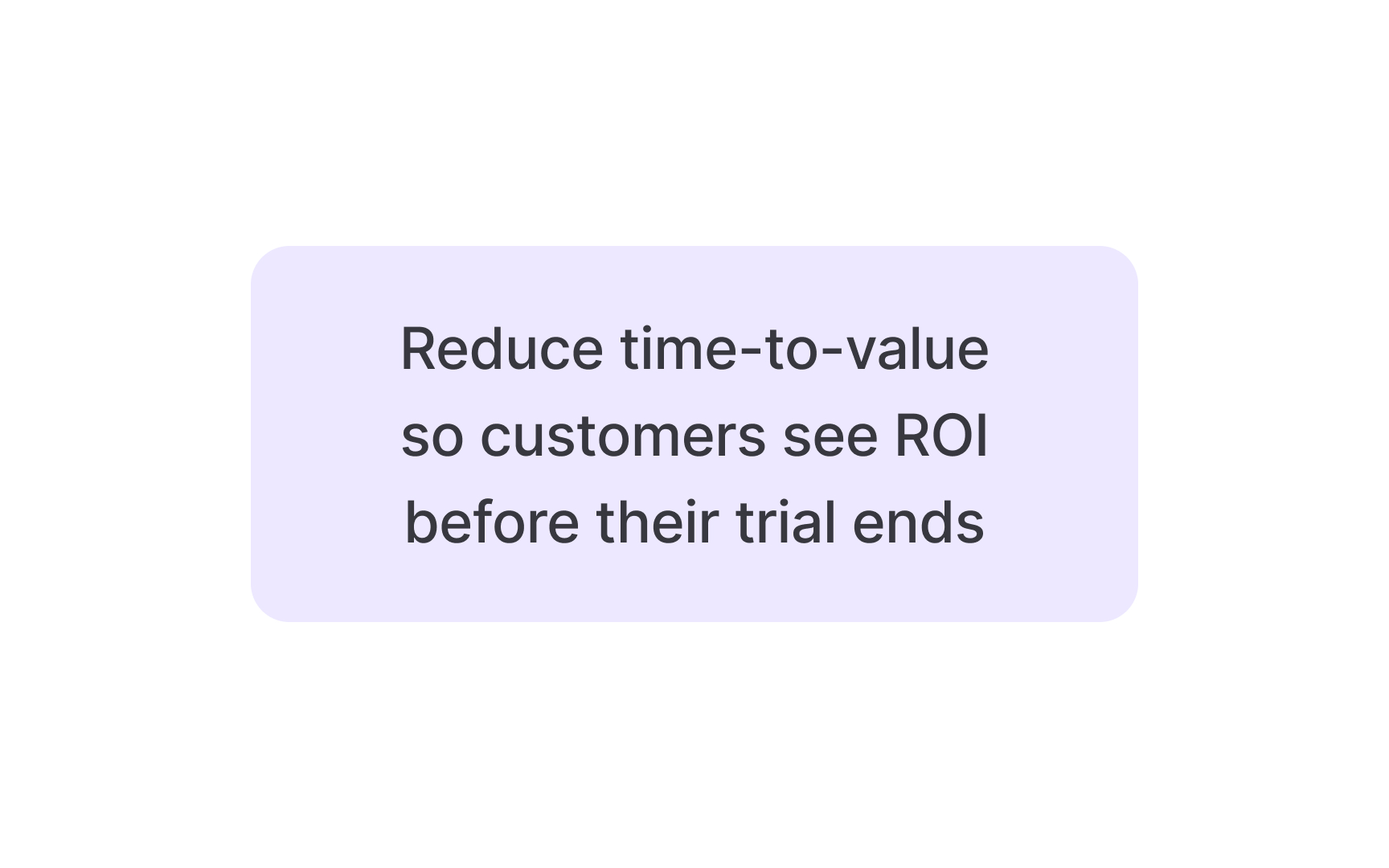
Strategic goals often span multiple years and describe broad outcomes like "become the market leader in mobile analytics." Objectives need to be more focused and achievable within a quarter or year. Translation involves breaking down strategic goals into specific, time-bound objectives that represent meaningful progress. If your strategy emphasizes customer retention, one quarterly objective might be "Make onboarding so valuable that new users become active within their first week."
Good objectives inherit the ambition of strategic goals while being concrete enough to guide team priorities. They should pass the "So what?" test — a simple check where you ask whether achieving this objective would represent meaningful strategic progress. If the answer is just "we completed some tasks" rather than "we meaningfully advanced toward our strategic goals," the objective needs refinement. For example, "conducted 10 user interviews" doesn't pass the test (it's just activity), but "validated that customers will pay 3x more for real-time collaboration features" does pass (it represents real strategic learning that informs product decisions).
Avoid objectives that are simply restated strategies or vague aspirations. "Improve the product" fails because it doesn't indicate what improvement looks like or why it matters strategically.
Key results measure progress toward objectives, but the metrics you choose should reflect strategic priorities. Wanting to improve generic metrics like NPS or conversion rate without any context may not capture what matters for your specific strategic direction. Strategic choices demand tailored metrics. If your strategy focuses on serving agency clients, key results might track agency-specific outcomes like "12 client projects created on the platform" rather than general usage numbers.
Keep in mind that the metric should make sense only in the context of your strategy. A key result measuring "support tickets from enterprise accounts" signals a specific strategic focus that wouldn't apply to a consumer-first strategy. Select 2-4 key results per objective that together paint a complete picture of success. Combine leading indicators (actions happening now, like feature adoption) with lagging indicators (results achieved, like
A North Star metric represents the single most important measure of value your product delivers to customers. It serves as a guiding light for all product decisions and OKRs.[3] This metric should capture the core value exchange between your product and users. For Spotify, this is “time spent listening.” For Airbnb, it’s “nights booked.” The right North Star reflects what success means for your specific strategy.
Not every metric qualifies as a North Star. It should correlate with customer value, predict revenue or growth, and be influenceable by the product team. It also needs staying power, remaining relevant even as tactics change. Your North Star constrains and guides OKRs. Objectives should contribute to moving this metric, either directly or through supporting drivers. This creates coherence across teams while allowing flexibility in how each team contributes.
Annual strategy sets the direction for the year, but quarters provide the execution rhythm. Quarterly OKRs break annual ambitions into achievable chunks while maintaining strategic alignment. Start by identifying what must be true by year's end to achieve your annual strategy. Then work backward to determine what progress looks like at each quarterly checkpoint. Q1 might focus on foundation-building while Q4 emphasizes scaling.
Not every strategic priority appears in every quarter. Sequencing matters. Some objectives require earlier work to be complete before they become relevant. Others need sustained attention across multiple quarters. Leave room for learning between quarters. Quarterly OKR cycles should include reflection on what worked and what didn't. This feedback informs the next quarter's priorities without abandoning the annual strategy.
Product-level OKRs represent outcomes for the entire product. Team OKRs translate these into specific commitments each team makes toward the shared goals. The connection should be clear but not rigid. Teams need autonomy to determine how they'll contribute to product objectives. A product objective about improving activation might lead one team to focus on
Avoid simply dividing product key results among teams. Instead, ask each team what meaningful contribution they can make toward the objective. This approach respects team expertise while maintaining alignment. Team OKRs should be mutually supportive. When setting team goals, check that they don't conflict with what other teams are trying to achieve. Dependencies should be visible and coordinated during planning.
Good measurement starts with clarity about purpose. Before tracking any metric, ask yourself what decision it will help you make. If you can't explain how a measurement will influence your choices, it probably isn't worth tracking. Every metric in your OKR system should answer a specific question about strategic progress.
Data quality matters more than quantity or sophistication. The most elegant OKR framework fails when built on unreliable data. Invest in data integrity first because decisions based on flawed numbers lead to worse outcomes than informed intuition. Before expanding what you measure, make sure your core metrics are accurately and consistently captured.
Remember that metrics support human judgment but don't replace it. Numbers can't capture every nuance of customer experience or product success. Complement your OKR tracking with qualitative insights from user research and customer conversations. The most successful teams use metrics as guidance while recognizing the limitations of pure quantitative measurement.
Strategy isn't static. Market conditions change, new information emerges, and strategic bets sometimes don't pan out. When strategy shifts, OKRs need to adapt accordingly.
However, not every pivot requires changing OKRs. Minor tactical adjustments can happen within existing objectives. For example, if your objective is "Make
Handle mid-cycle changes thoughtfully. Document why the shift happened, what you learned, and how new OKRs connect to the updated strategy. This preserves institutional knowledge and maintains trust in the OKR process.
References
Topics
From Course

Share


Similar lessons

Continuous Discovery Mindset

Business Outcomes vs. Product Outcomes