Customer Journey Map for a Co-Working Space


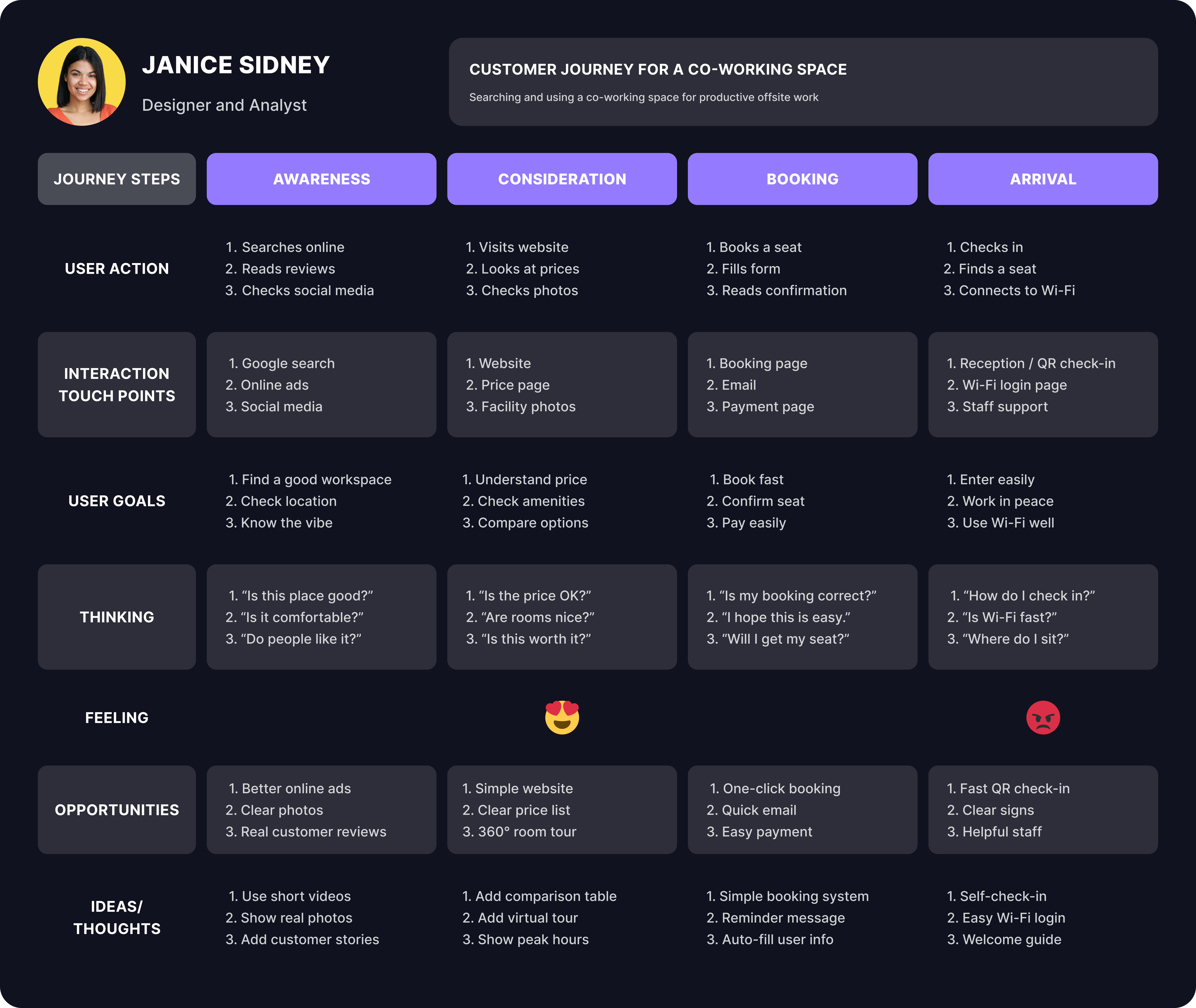
In this project, I made a Customer Journey Map (CJM) for a co-working space. The goal of this project is to understand how customers feel and what they need when they use the co-working space. I also want to see the problems they face and how the service can be better.
First, I chose a target user: a freelance worker who needs a quiet place to work. Then, I wrote the steps of their journey, starting from searching for a co-working space until leaving the place. I looked at their actions, feelings, goals, and pain points in every step.
I decided to make this map because it helps the business understand the customer experience more clearly. It shows what customers like and what they do not like. With this information, the co-working space can improve its services, such as making easier booking, giving better Wi-Fi, or creating a more comfortable workspace.
I used simple categories in the CJM: Awareness, Consideration, Booking, Arrival, Working Experience, and Leaving. For each stage, I wrote short and clear points to show the customer’s experience.
This CJM helps the project because it gives a full picture of the customer journey and helps us make better decisions to improve the co-working space.

Reviews
6 reviews

Layyin, your Customer Journey Map (CJM) for the co-working space has a strong foundation — you’ve structured it logically from Awareness → Leaving, and including actions, feelings, and goals at each stage shows you understand the essentials of journey mapping.
Strengths:
- Clear stages make it easy to follow.
- Focus on a target user (freelancer) keeps it relatable.
- Using Figma/FigJam gives flexibility for visual storytelling.
Opportunities for improvement:
- Deepen empathy: Go beyond generic goals like “work in peace.” Include real frustrations (Wi-Fi lag, seat availability, noise, check-in delays).
- Emotions: Use richer emotion indicators — emojis help, but consider a range from frustration → satisfaction to visualize pain points clearly.
- Pain points & opportunities: Highlight them explicitly per stage. For example, slow Wi-Fi → implement self-check-in or quick Wi-Fi login.
- Working Experience stage: This is the core of the service. Map touchpoints like desk setup, amenities usage, interactions with staff, and ambient noise management.
Your CJM is actionable with some refinement — if you combine real user research or even deeper empathy-based assumptions, you’ll transform it from a structural outline into a powerful tool for improving service design.
Your CJM is well structured.
To improve, create a user persona stating his/her pains. Based on user persona, in particular the pains, map the customer journey would be more realistic in solving "real-world problems".
All in all, great job!

Hey! I can see you approached this systematically and the effort is really visible. The map has a solid structure and you show that you understand the basic elements of a customer journey. That's a good foundation.
However, to be honest, it lacks the depth that distinguishes a real map from a table with headers. User goals are generic "work in peace" could apply to any workplace. Thinking shows surface-level questions, but I don't see the user's real dilemmas. Emotions? Two emojis for the entire journey is too little. Where's the frustration with slow WiFi, stress during payment, relief after finding a good spot?
Opportunities and Ideas look like a wishlist of fancy features ("360° room tour") instead of real, simple improvements based on specific problems. Most importantly I don't see pain points, and that's the heart of every CJM. Without them, you don't know what to fix.
You have a good skeleton, but you need to fill it with real insights from research or at least deeper empathy. With this foundation, you can really push this to something valuable! 😊👍

Hi Janice 👋
I enjoyed reviewing the customer journey map for the coworking space project. The structure is comprehensive, and mapping out the user's emotional journey alongside their actions and touchpoints makes identifying pain points and improvement opportunities easy.
Defining a specific persona and breaking down the journey into clear stages is an effective approach. The combination of user goals, thought processes, and emotions provides stakeholders with a complete picture. I particularly appreciate how you've translated insights into concrete opportunities. For example, you identified Wi-Fi login friction upon arrival and proposed solutions such as self-check-in and simplified login. This is what makes a CJM actionable rather than just documentation.
One suggestion: The journey effectively covers awareness through arrival, but the actual working experience phase appears to be missing. Since that's the core service moment, expanding the map to include touchpoints such as workspace setup, usage of amenities, noise management, and staff interactions during the stay could reveal optimization opportunities not visible in the booking funnel alone.
I'll definitely consider your approach to visualizing emotional shifts with emoji indicators in the "Feeling" row for my own journey maps. It communicates sentiment changes at a glance, which is useful for stakeholder presentations.
Overall, this is solid UX work that clearly demonstrates your research and synthesis skills.

You’ve put together a clear and easy-to-follow journey map, and the structure you’ve used makes it simple to understand how the user moves through each stage. The layout is clean, and the way you captured actions, thoughts, and feelings shows good intent to represent the user’s experience. That said, the overall output still feels a bit high-level and doesn’t fully connect back to the original brief. To make this truly strong from a service-design perspective, the journey needs more depth, especially around who the user really is, how competitors shape their expectations, and what specific opportunities can create meaningful improvement. With a bit more context and sharper insights, your CJM can become much more actionable and compelling.
Areas of Improvement
- You’ll need to bring back some missing parts of the brief, especially the persona, the chosen co-working service, and a quick competitor scan.
- The persona can be richer; right now it’s too generic. Add motivations, struggles, and what “success” looks like for them.
- Your map mentions “Working Experience” and “Leaving,” but these stages don’t show up in the visual. Adding them will make the journey complete.
- Try to include more service-level insights, like where operational issues happen or where the system breaks down.
- The opportunities you listed are good starting points, but they’ll be stronger if they directly tie back to a specific pain point.
- Emotions can be described more specifically instead of just emojis, what exactly frustrates or delights the user?
- A light comparison with competitors (WeWork, CO+HOOTS, etc.) will help show why these improvements matter.

This is an excellent and greatly structured CJM that successfully achieves its goal by mapping User Actions to Thinking and Feeling states, clearly highlighting pain points like friction during Booking and frustration upon Arrival. The map’s strength lies in its empathy and clarity, providing a robust foundation for service improvement. To finalize this as a complete service design artifact, two additions I would recommend: first, expand the journey to include the Working Experience/Retention stage, which captures the core value proposition (e.g., quality of quiet zones and Wi-Fi); and second, introduce a Metrics/KPIs row for each stage to quantify issues like "Booking Abandonment Rate," ensuring derived opportunities are prioritised by business impact.
You might also like

A/B Test for Hinge's Onboarding Flow


Smartwatch Design for Messenger App


GetTracky


Bridge: UI/UX Rebrand of a Blockchain SCM Product


Uxcel Halloween Icon Pack


Pulse Music App - Light/Dark Mode

User Research Courses

Ethical & Responsible Product Design


The Product Development Lifecycle & Methodologies


Writing Effective Product Specs
