CJM for Leo

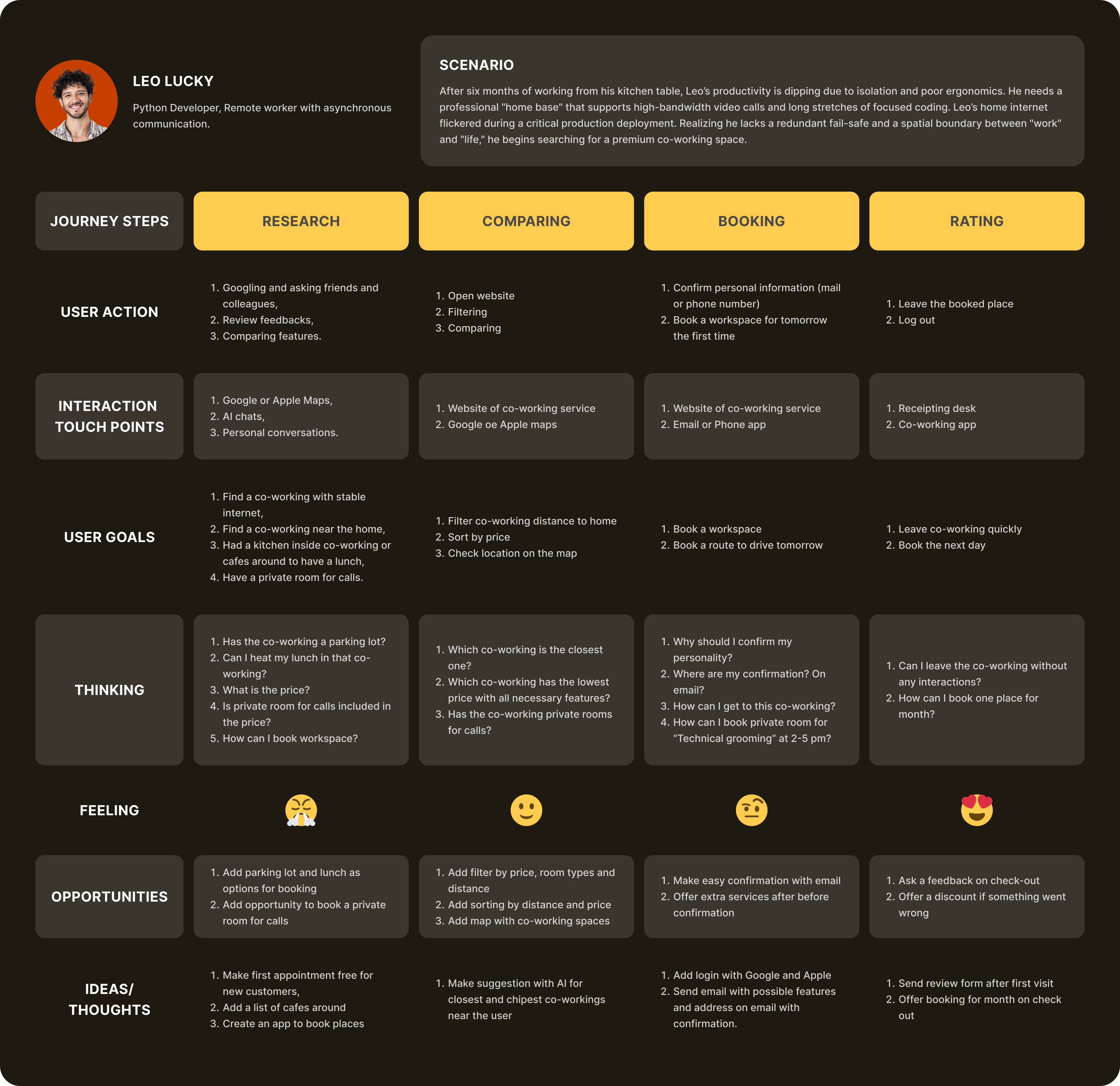
CJM of the website with many co-workings for Leo, Python developer

Reviews
2 reviews

Good job, Mariia! I like the CJM. It clearly shows the user’s needs and makes the coworking discovery journey easy to follow. I have a few suggestions that might help strengthen the logic and connections between stages:
- It could be helpful to more clearly connect user goals, thoughts, pain points, and needs. For example, in the research stage, the user’s goal is to find a coworking space with stable internet, close to home, and with a private room. However, in the “thoughts” section, there is a question about whether the coworking has a parking lot. That’s a valid question, but the scenario doesn’t mention that the user uses a car. If location and distance are important enough to sort by, you might also consider adding opportunities that help the user understand how to get to the place (e.g., public transport options) in case parking isn’t available.
- During the booking stage, you raised a very good question: why does the user need to confirm their personal data? It would be great to reflect this in the opportunities as clear actions, either we explain why this data is needed, or we remove the step to reduce friction.
- I like that you included the “leaving the coworking” stage. At the moment, though, it feels a bit light on opportunities. If there are additional steps in this phase, you could expand them beyond asking for feedback or offering a discount to better close the experience.
Overall, this is a solid CJM with good structure. With a bit more alignment between intentions, thoughts, and actions, it can become even stronger.

Hi Mariia!
From a strategic standpoint, this CJM feels structured and intentional rather than surface-level. I can sense that you were trying to understand Leo’s experience holistically not just the touchpoints, but the emotional shifts across the journey. That’s what differentiates a real journey map from a diagram.
What stands out is the clarity in stages. The progression appears logical, and that helps reveal where friction and opportunity truly sit. A strong CJM isn’t about filling rows it’s about exposing tension points that can guide product decisions.
If I were refining this further, I’d emphasize prioritization. Highlighting which moments matter most and why would strengthen its impact as a decision-making tool. Overall, this reflects thoughtful UX analysis with a solid foundation in experience thinking.
You might also like

Smartwatch Design for Messenger App


Bridge: UI/UX Rebrand of a Blockchain SCM Product


Pulse Music App - Light/Dark Mode


Monetization Strategy


Designing A Better Co-Working Experience Through CJM


Design a Settings Page for Mobile
User Research Courses

Ethical & Responsible Product Design

Product Management Foundations


The Product Development Lifecycle & Methodologies