Boutique Coffe Shop Persona

1Defining the Business Context
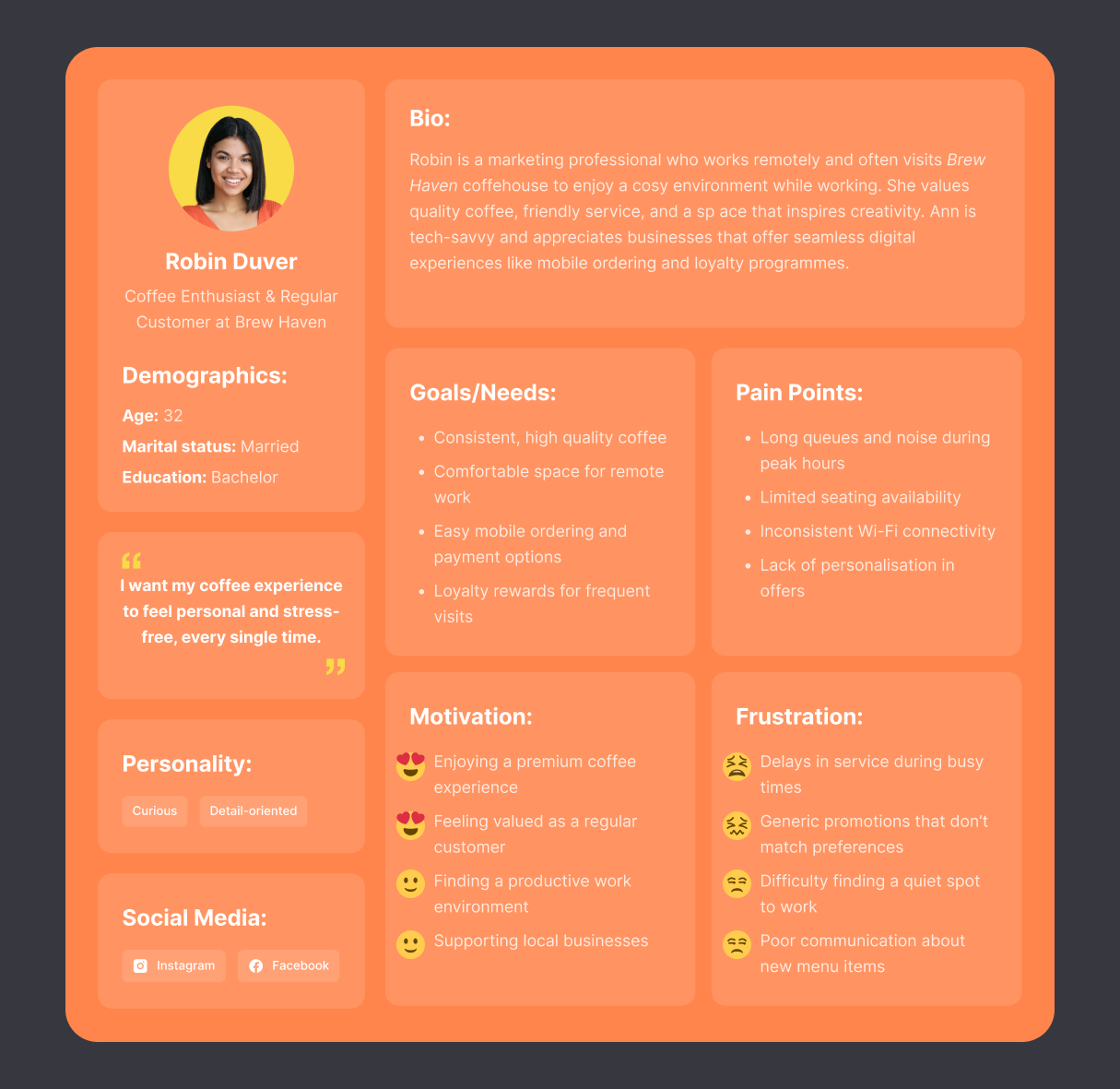
The first step was to select a business type that allows for rich user behaviour and motivations. I chose a boutique coffee shop because it represents a service-oriented environment where customer experience is critical. This context provides clear touchpoints (ordering, seating, ambience, and loyalty programmes) that influence user needs and frustrations.
Identifying the Target User
I imagined a remote-working professional as the primary persona because:
- Coffee shops often attract individuals seeking a productive yet social environment.
- This segment values convenience, quality, and digital integration (e.g., mobile ordering).
- Their behaviour reflects a mix of functional and emotional needs, which makes for a well-rounded persona.
Structuring Demographics
Demographics were chosen to reflect a realistic and relatable profile:
- Age (32): Represents a mid-career professional who balances work and lifestyle.
- Education (Bachelor’s in Marketing): Suggests tech-savviness and appreciation for branding and experience.
- Marital Status (Married): Adds context for time management and lifestyle choices.
These details help stakeholders empathise with the persona and design solutions that fit their life stage.
Crafting the Bio
The bio was intentionally kept short and focused to avoid cognitive overload while still conveying:
- Role: Remote-working professional.
- Behaviour: Visits coffee shops for productivity and ambience.
- Values: Convenience and personalisation.
This ensures the persona feels human without overwhelming the reader with unnecessary details.
Selecting Goals and Needs
Goals were derived from common customer expectations in a coffee shop setting:
- Quality coffee: Core product expectation.
- Comfortable workspace: Aligns with remote work trends.
- Digital convenience: Reflects modern consumer behaviour.
- Loyalty rewards: Encourages repeat visits.
These goals guide design decisions for both physical and digital touchpoints.
Pain Points
Pain points were chosen to highlight experience gaps that often lead to dissatisfaction:
- Long queues → Operational inefficiency.
- Limited seating → Spatial design challenge.
- Poor Wi-Fi → Functional barrier for remote workers.
- Lack of personalisation → Missed opportunity for engagement.
Each pain point signals an actionable area for improvement.
Personality Tags
Instead of generic traits, I opted for behavioural descriptors relevant to decision-making:
- Curious: Open to trying new menu items.
- Detail-oriented: Notices quality and service nuances.
- Sociable: Enjoys interaction with staff and community.
- Goal-driven: Visits with a purpose (work or leisure).
- Adaptable: Comfortable with changing environments.
These traits inform tone and interaction design (e.g., offering personalised recommendations or creating community-driven experiences).
Motivations and Frustrations
Motivations were tied to emotional drivers (premium experience, local support) and functional needs (productive environment).
Frustrations were mapped to service gaps (delays, generic promotions) that could erode loyalty.

Reviews
2 reviews
Great start, Francesca! I like how you caught in your persona the right context & information for people that are reading about it to be able to understand and empathize with.
Make sure in the future to keep the visual as simple as possible (KISS principle). The white text on orange currently is hard to read and to be honest is also a bit distracting from the content.
I understand you imagined your persona and you described it based on your assumptions or maybe based on your past experiences with coffee shops or stories you heard in the past.
The brief clearly states that research needs to be present in your project, and done before starting your persona and that is for a good reason 😁, because in general is best practice to validate your assumptions and do any kind of research that you are able to do (survey, interviews with some friends of yours that you can ask to help you with a project, observations) and you need to document your findings, maybe even do an affinity mapping to identify patterns in results you find in your research and then and only then, based on the information you decide how your persona is built. For example, you might have found out that you need actually, based on the patterns you found, to build multiple personas, like 2 or 3, because your findings where too different to be assigned to a single persona.
Best of luck in your work and keep creating and being awesome!

This is a really good start!
I would have liked to see this based more off of research or if there was research see more of that included. Right now it comes across as being based off of assumptions and even though you might be correct, backing up claims with research always is more convincing to stakeholders than not.
Also this template color contrast really lacks accessibility considerations. The white text on bright orange is super jarring and hard to read, and can be even more difficult to read if someone is vision impaired.
Keep up the good work, you're defining going somewhere with this! The layout is very clean and scannable otherwise.
You might also like
Events Managment App

Customer Journey Map — Offsite Co-Working Experience

Mobile Onboarding: Casa di Pasta

Accessible Signup & Login Experience — Brainex

Accessible Signup Form
Accessible Signup Form

User Research Courses

Ethical & Responsible Product Design

Introduction to Product Management


The Product Development Lifecycle & Methodologies