Using the Product Strategy to Prioritize
Learn how to connect every prioritization decision to your product strategy for faster alignment and clearer roadmaps
Product strategy defines the choices your organization makes about where to play and how to win. These choices directly shape what gets prioritized. Without strategy, prioritization becomes a popularity contest where the loudest voice or highest-paid person wins. Strategy provides the "why" behind prioritization decisions. Consider Tesla's approach: their strategy of starting with high-end vehicles to fund mass-market development meant every early feature prioritization supported premium buyer expectations first.[1] The result of strategy-driven prioritization is faster decisions, stronger stakeholder buy-in, and a roadmap that genuinely advances your product vision rather than just shipping features.
Your product strategy contains implicit
Most teams need 3-5 criteria to balance thoroughness with practicality. Too few and you miss important dimensions. Too many and scoring becomes burdensome. Each criterion should connect directly to a strategic choice. If you cannot trace a criterion back to your strategy, question whether it belongs. Weight your criteria based on current strategic priorities. A criterion tied to your primary strategic bet should carry more weight than secondary considerations.
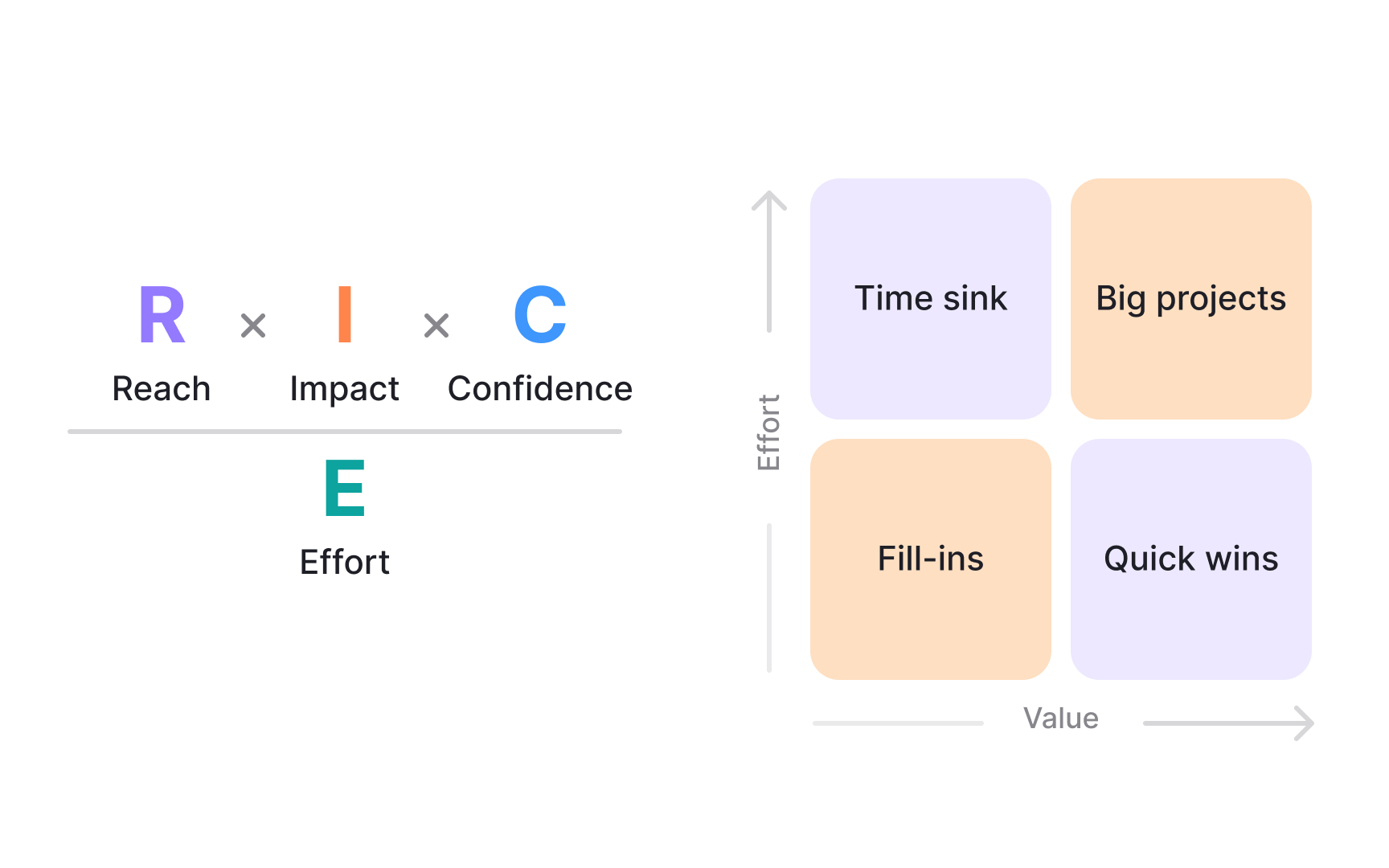
- RICE framework: This scores each feature across 4 dimensions: Reach (how many users will this affect?), Impact (how much real value does a feature add for users and the business?), Confidence (how certain are we about our estimates?), and Effort (how much time and resources will this require?). To connect RICE to strategy, define "Impact" specifically as how much a feature advances your strategic outcomes.[2]
- Value vs effort matrix: This plots features on a simple grid with two axes. The vertical axis represents strategic value (how much it moves you toward your goals — not just revenue). To align with your strategy, define value based on what matters most right now, such as user retention, market positioning, or solving key customer problems. The horizontal axis represents implementation effort (resources and time needed). Features landing in the top-left quadrant (high value, low effort) are "quick wins" you should tackle first. Features in the top-right (high value, high effort) are "big bets" that need careful evaluation before committing.[2]
- MoSCoW method: This categorizes every feature into one of 4 buckets: Must Have, Should Have, Could Have, or Won't Have. To make this strategic rather than arbitrary, your "Must Haves" should be features that are essential to achieving your strategic objectives. This prevents the framework from becoming a mechanical checklist disconnected from what actually matters.[3]
Weighted scoring helps you compare features by converting strategic alignment into measurable numbers. Here's how it works step-by-step:
- List your strategic goals: Identify 3-5 key strategic goals that will serve as your scoring criteria.
- Assign weights: Give each goal a percentage weight based on its importance. All weights must add up to 100%.
- Choose a scoring scale: Use a consistent scale (like 1-5) to rate how well each feature supports each goal.
Imagine a project management tool whose strategy focuses on team collaboration. They set up their scoring criteria like this: improves team communication (40%), reduces task completion time (30%), increases daily active usage (20%), and lowers support tickets (10%). Now they want to evaluate a real-time commenting feature. They score it against each criterion: communication 5 out of 5, task completion 3 out of 5, daily usage 4 out of 5, and support reduction 2 out of 5.
To calculate the weighted score, multiply each score by its weight, then add them together: (5 × 0.4) = 2.0, (3 × 0.3) = 0.9, (4 × 0.2) = 0.8, and (2 × 0.1) = 0.2. The total score is 3.9 out of 5. Compare this score against other features to determine priority order — the higher the value, the higher the priority. Document your rationale so stakeholders understand how strategic alignment drove each decision.
Pro Tip: Keep scores visible to your team. Transparency in scoring builds trust and reduces priority disputes.
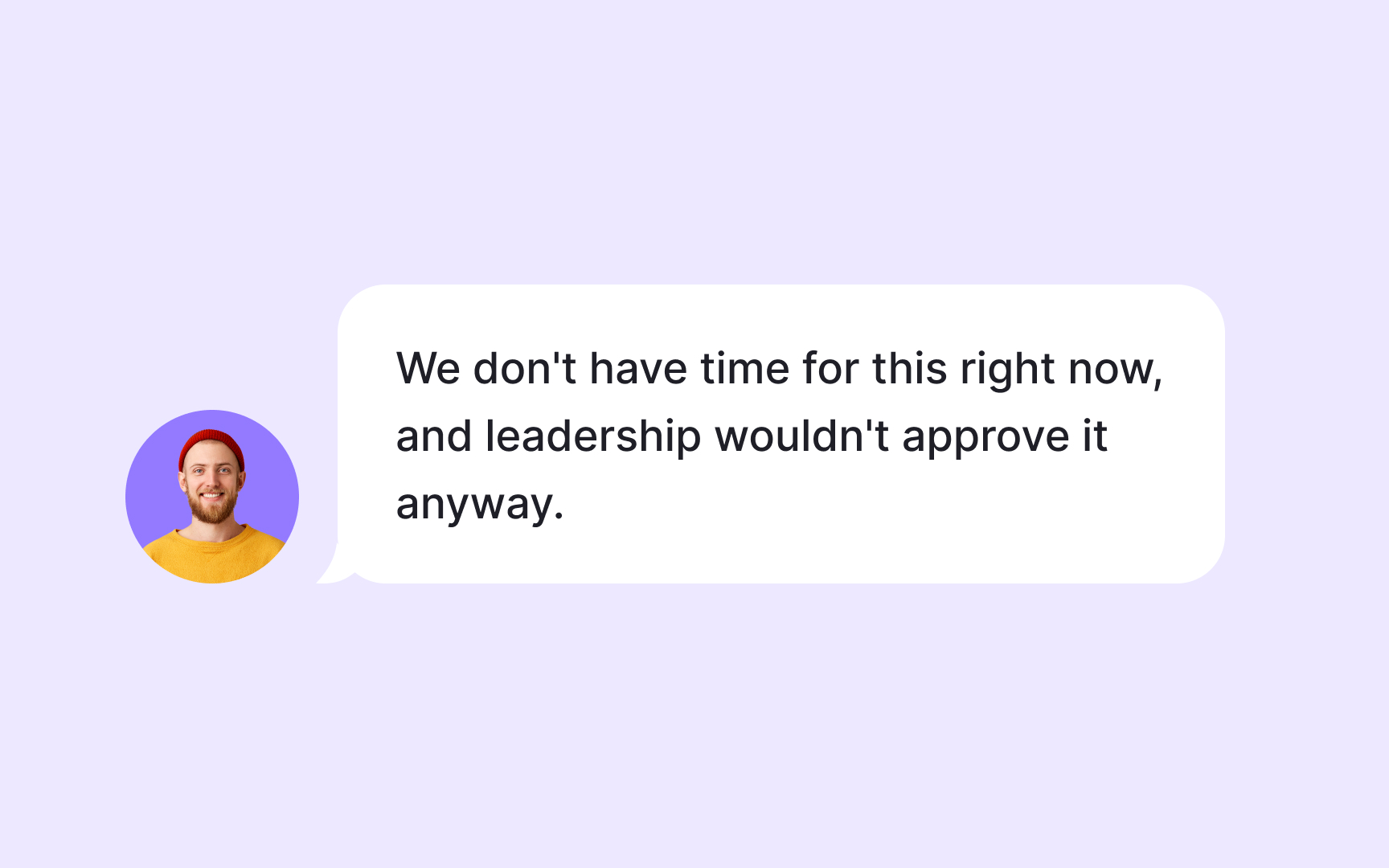
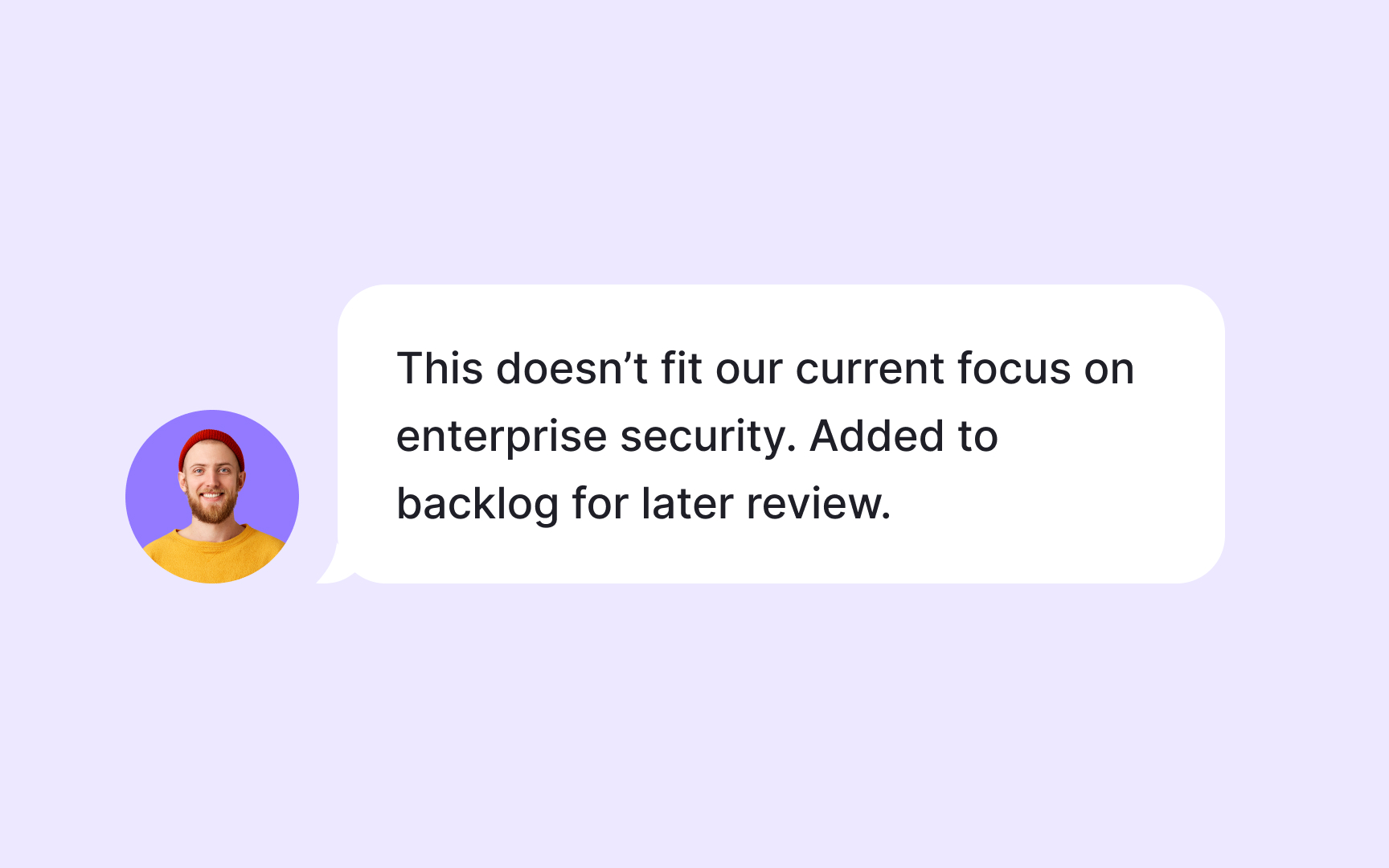
Strategy is as much about what you won't do as what you will. Every strategic choice implies rejected alternatives. Use this to say no confidently when feature requests fall outside strategic boundaries. Frame rejections around strategic fit, not personal preference. Instead of "We don't think that's a good idea," say "That doesn't align with our current strategy of targeting mid-market customers." This shifts the conversation from opinion to objective criteria. Stakeholders may disagree with your strategy, but that becomes a separate discussion.
Create a "parking lot" backlog for strategically misaligned requests that might fit future directions. This acknowledges the idea's potential value while maintaining current focus. Document why items land there. When strategy evolves, you can revisit these items with fresh criteria. Saying no protects your team's capacity for work that actually advances strategic goals. Every yes to a non-strategic feature is a no to something that matters more.
Product teams face constant tension between long-term strategic bets and short-term tactical needs. Strategic bets are investments in future growth that may not pay off immediately. Tactical needs address current customer pain points, technical debt, or competitive pressures. A healthy roadmap includes both. Pure strategic focus ignores today's customers and accumulates technical debt. Pure tactical focus keeps you running in place without advancing toward your vision. The balance depends on your product's maturity and market position.
Early-stage products typically lean toward strategic bets to establish market position. Mature products may shift toward tactical improvements that protect existing
When your product serves multiple customer segments,
Start by mapping features to the segments they serve. Some features benefit all segments equally. Others serve specific segments exclusively. When resources are limited, features serving your primary strategic segment should generally win.
However, ignoring secondary segments entirely creates risk. A balanced approach allocates capacity across segments proportionally to their strategic importance. If enterprise customers represent your primary growth strategy with mid-market as secondary, your roadmap might allocate 60% to enterprise needs and 30% to mid-market. The remaining 10% addresses shared needs. When segment needs directly conflict, escalate to strategic discussion rather than making ad-hoc tradeoffs. These conflicts often reveal strategic ambiguity that leadership needs to resolve.
Even sound
Tailor your message to the audience. Executives need high-level strategic alignment summaries. Engineering teams need enough context to understand why their work matters. Sales and customer support and success teams want to know how priorities address customer feedback they've shared.
Use visual roadmaps to show the connection between strategy and priorities. Group features under strategic themes or
Sometimes urgent priorities emerge that conflict with stated strategy. A major customer threatens to churn without a specific feature. A competitor launches something that pressures immediate response. Technical infrastructure fails and demands unplanned investment. Not every conflict signals a problem. Some conflicts are genuine emergencies requiring temporary strategic deviation. The key is making these tradeoffs consciously rather than reactively. When faced with a conflict, ask: "Does this change our strategy, or is it a one-time exception?"
However, if conflicts happen frequently, your strategy may be misaligned with market reality. Frequent competitive responses suggest your differentiation strategy needs work. Constant customer escalations might indicate you've targeted the wrong segment. Track priority conflicts over time. Patterns reveal strategic gaps. One-off conflicts are normal operating noise. Recurring conflicts are strategic signals demanding attention. Use conflicts as strategy stress tests rather than simply overriding your
Strategy is not static. Market conditions shift, competitors move, and customer needs evolve. Your
Maintain traceability between strategy versions and prioritization decisions. When stakeholders ask why something moved on the roadmap, you can point to specific strategic shifts that drove the change. This builds confidence in your process even when priorities feel volatile.
Distinguish between strategic pivots and strategy refinements. Pivots require complete reprioritization. Refinements need targeted adjustments. Reacting to every market signal with full reprioritization creates chaos. Build strategic resilience by defining which signals warrant major changes versus minor tuning.
References
- You Don't have a Prioritization Problem, You have a Strategy Problem by Ant Murphy | Thoughts about Product Adoption, User Onboarding and Good UX | Userpilot Blog
- RICE Scoring Model | ProductPlan
- MoSCoW Prioritization | ProductPlan
Topics
From Course

Share


Similar lessons

Continuous Discovery Mindset

Business Outcomes vs. Product Outcomes