Shifting your product mindset from output-focused to outcome-focused product management
Learn how to stop measuring success by features shipped and start measuring it by problems solved

You just shipped a feature. The code is live. The design looks great. Everyone high-fived on Slack. But 3 months later, nobody's using it. The metrics haven't budged. And you're left wondering: what was the point?
You’ve just made the most common mistake in product management. You built the thing. You just didn't build the right thing. Or maybe you built it in a way that didn't actually solve the problem you thought it would.
The shift from output-focused to outcome-focused thinking is the single biggest mindset change you'll make as a PM. It's the difference between being a feature factory and being someone who actually moves the needle for your users and your business.
Why shipping isn't winning
Here's what output-focused thinking sounds like:
- "We shipped 12 features this quarter!"
- "The redesign is live!"
- "We hit our sprint velocity targets!"
- "The new dashboard is done!"
None of these statements tells you whether anything actually improved. They just tell you that work happened. Output-focused teams celebrate activity. They measure success by how much stuff gets built, how many tickets get closed, and how many releases go out the door. It feels productive because things are moving. But movement isn't progress.
But...did those 12 features solve real problems? Did the redesign make users more successful? Did hitting velocity targets mean you built valuable things or just things?
What outcome-focused actually means
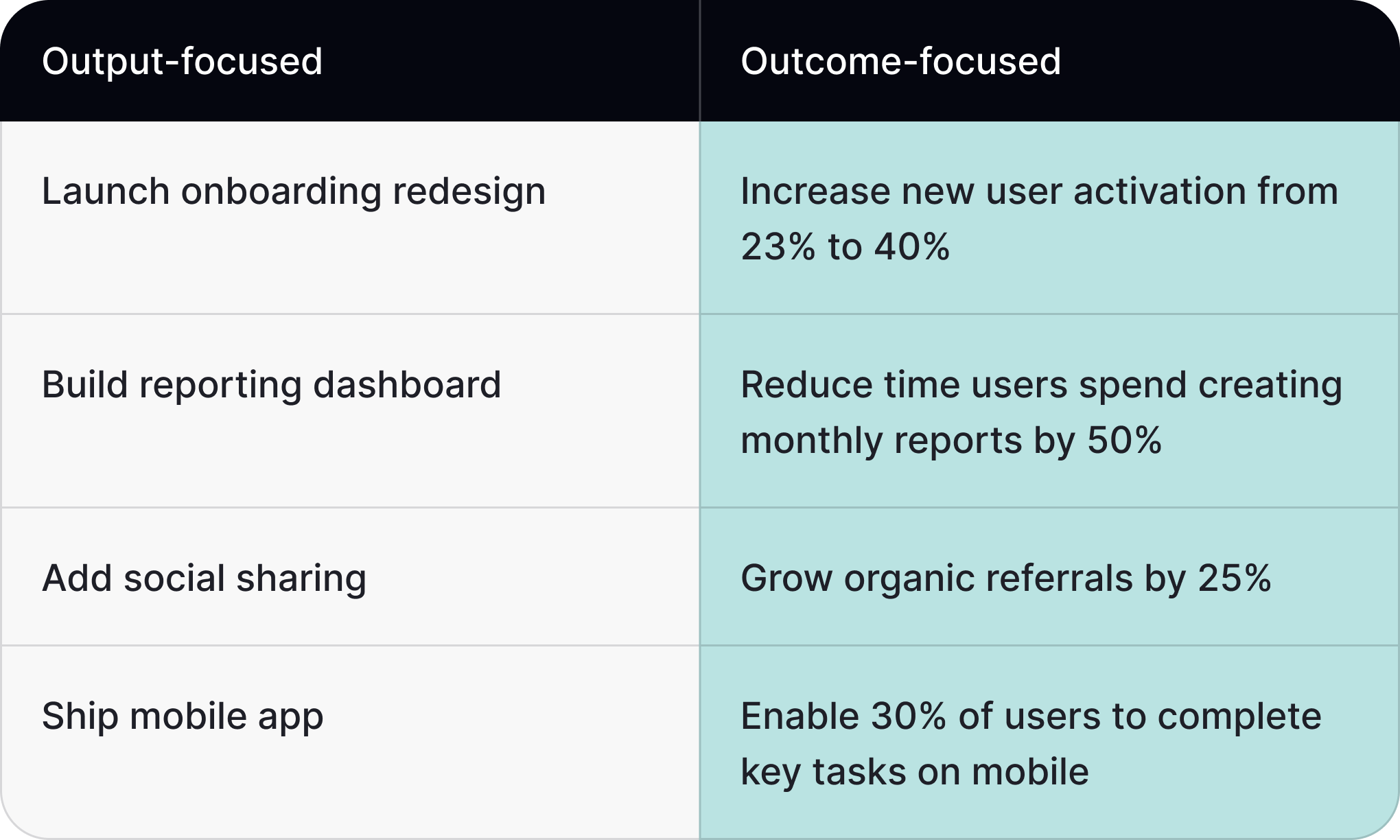
Outcome-focused thinking flips the script. Instead of starting with "what should we build?", you start with "what should change?"
An outcome is a measurable change in human behavior or a business result. Not a feature. Not a deliverable. A change.
Here's the same work, reframed:
Why this shift is harder than it sounds
If outcome-focused thinking is so obviously better, why doesn't everyone do it? Because outputs are comfortable and outcomes are scary. Plus:
- Outputs are within your control. You can guarantee that a feature ships. You can't guarantee that users will behave differently because of it.
- Outputs are easy to measure. Did the code go live? Yes or no. Did user behavior change? That requires actual analysis.
- Outputs feel like progress. Shipping something gives you an instant dopamine hit. Waiting to see if it worked requires patience.
- Outputs make stakeholders happy (temporarily). Executives love hearing "it's done." They're less excited by "we're still measuring impact."
The shift to outcomes means accepting uncertainty. It means admitting that your brilliant idea might not work. It means being accountable for results, not just effort. That's uncomfortable. But it's also where real product thinking lives.
How to actually make the shift
1. Start by reframing every request
When someone asks for a feature, your job is to dig for the outcome hiding underneath.
Stakeholder says: "We need to add a chat feature."
You ask: "What problem would chat solve? What would change for users if we had it?"
Stakeholder says: "Customers are emailing support with questions they could answer themselves."
Now you know: The outcome isn't "have chat." It's "reduce support tickets for self-serviceable questions."
Suddenly, you have options. Maybe chat is the answer. Maybe better documentation is. Maybe a smarter search function is. The outcome stays fixed; the solution becomes flexible.
2. Define success before you build anything
Before a single line of code gets written, answer these questions:
- What behavior are we trying to change? Be specific. "Users will do X instead of Y" or "Users will do X more often."
- How will we measure that change? What metric moves? Where does that data come from? Can you actually track it?
- What does "good enough" look like? If you increase activation from 23% to 30%, is that a win? What about 25%? Know your threshold.
- How long until we know? Some outcomes show up in days. Others take months. Set a realistic evaluation window.
Write these answers down. Share them with your team. Now everyone knows what you're actually trying to achieve and not just what you're building.
3. Run experiments, not projects
Output-focused teams build features. Outcome-focused teams run experiments.
The difference is that experiments have hypotheses. They're designed to learn something. And they come with the explicit possibility of being wrong.
Here's the format:
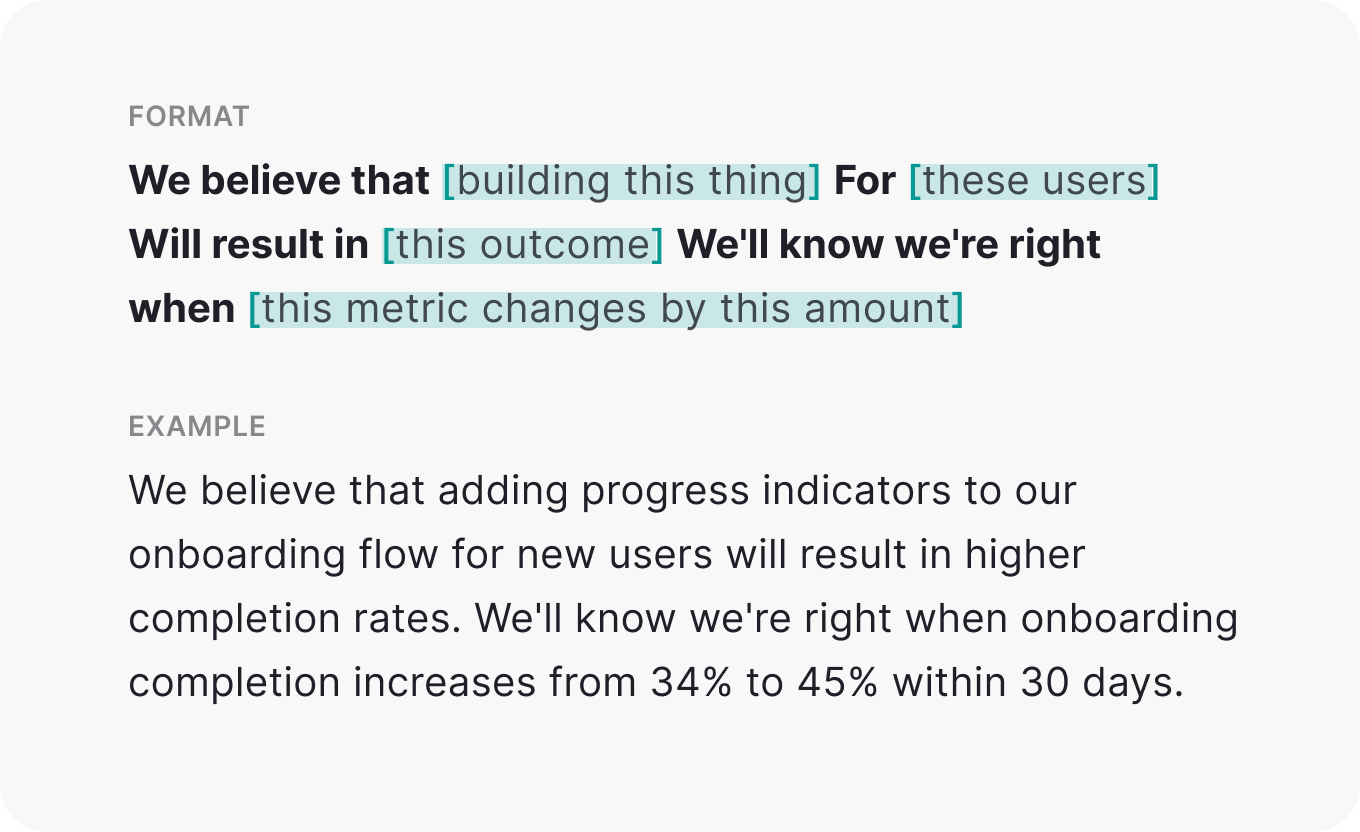
Now you're not just shipping a feature. You're testing a hypothesis. If you're wrong, you've learned something valuable. If you're right, you've proven impact.
Keep in mind, before building a working prototype, you can test this idea using low-fi wireframes. This helps you validate the direction early and avoid costly development if the assumption is wrong. If you're wrong, you've learned something valuable. If you're right, you've proven impact.
4. Get comfortable with "it didn't work"
This is the hard part. Sometimes your hypothesis is wrong. You test an idea, but the metrics don’t move, and you have to admit that it didn’t solve the problem.
When something doesn't work, ask:
- Was our hypothesis wrong? (Maybe progress indicators don't matter as much as we thought)
- Was our execution wrong? (Maybe the indicators were confusing)
- Was our measurement wrong? (Maybe we weren't tracking the right thing)
Each answer points you toward what to try next. That's iteration.
5. Change how you report progress
Stop saying: "We shipped the new checkout flow." Start saying: "We shipped the new checkout flow. Early data shows cart completion up 12%. We're tracking toward our 20% improvement goal."
Stop saying: "The mobile app is 80% done." Start saying: "We've validated that mobile users complete purchases at desktop-equivalent rates in beta testing. Full rollout next month."
When you tie everything back to outcomes, you train your stakeholders to care about outcomes too. Eventually, they'll start asking "what changed?" instead of "what shipped?"
Common traps
1. The vanity metric trap
Not all metrics are outcomes. "Page views increased 50%" sounds great until you realize those views aren't translating to anything meaningful.
Good outcome metrics are:
- Tied to real value: For users (they're more successful) or for the business (revenue, retention, etc.)
- Actionable: If the metric doesn't move, you can try something different
- Leading or lagging indicators of success: They predict or reflect actual impact
"Time spent in app" could be good (users finding value) or bad (users struggling to complete tasks). Context matters.
2. The false attribution trap
You shipped a feature. Metrics improved. Therefore, the feature worked, right? Maybe. Or maybe something else changed. A competitor went down. Marketing ran a campaign. Seasonality kicked in.
Outcome-focused teams think critically about causation:
- Can you compare users who got the feature vs. those who didn't?
- Did the change happen immediately after launch or gradually?
- Are there other explanations for what you're seeing?
You don't need perfect scientific rigor, but you do need intellectual honesty.
3. The short-term thinking trap
Some outcomes take time. If you're measuring success at one week post-launch, you might miss that:
- Initial excitement fades
- Users need time to form new habits
- Network effects take months to materialize
Build in longer evaluation windows for outcomes that genuinely need them. Not everything is a quick win.
What this looks like day-to-day
Outcome-focused thinking changes how you spend your time:
- In planning meetings: Instead of debating features, debate problems. "What's the biggest obstacle to user retention right now?" matters more than "should we build feature X or Y?"
- In stakeholder conversations: Translate requests into outcomes. "You want a mobile app. Is the outcome that users can access our product anywhere, or is it something else?" Keep digging until you find the real goal.
- In standups and check-ins: Talk about what you're learning, not just what you're doing. "We launched the new flow. Seeing 8% improvement in day-one retention so far, targeting 15%."
- In retrospectives: Evaluate against outcomes, not outputs. "We shipped everything we planned. But only 2 of 5 initiatives hit their target metrics. What can we learn?"
- In roadmap conversations: Frame initiatives by the problems they solve and the outcomes they'll drive, not just by what gets built.
TL;DR
The shift from output to outcome thinking is simple to understand and hard to practice. It requires:
- Asking "why" more than "what"
- Defining success before you build
- Accepting that some ideas won't work
- Measuring what matters, not what's easy
- Being patient when results take time
But this shift is what separates PMs who build stuff from PMs who build the stuff that matters. It's what turns feature factories into product teams that actually move the needle. Your job as a PM is to create change for your users and for your business. Start measuring yourself that way, and everything else follows.
Now go find an output on your roadmap and reframe it as an outcome. That's your first step.
P.S.: Check out our Product Discovery course to build a solid foundation in connecting your work to business outcomes.
You might also like

Breaking into Product Management Through Paths Less Traveled
Building Your First Product Roadmap: A Step-by-Step Guide

Communicating Across Teams

Popular Courses
Introduction to Product Management

The Product Development Lifecycle & Methodologies


Writing Effective Product Specs