Garden - Stakeholder Communication Plan

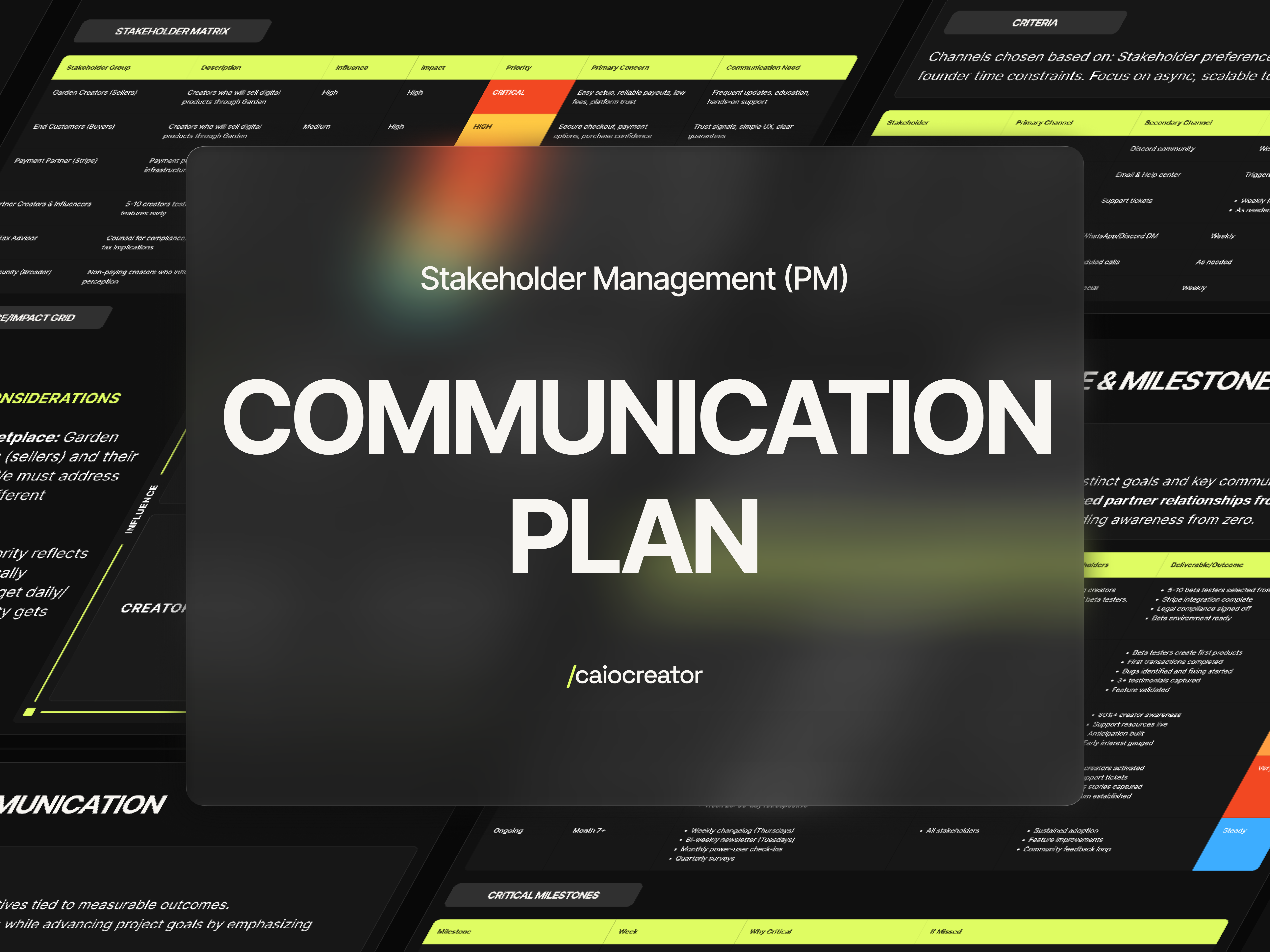
Hey, welcome. This is a stakeholder communication plan for Garden, a download gate platform I'm founding as a solopreneur.
Project Context
Garden will help creators grow their audience by exchanging content access for social media engagement. Think Hypeddit, but for all creator types — educators, designers, writers, coaches, and entrepreneurs.
Before We Begin:
- This is a lean startup artifact for a real business.
- MVP in development, no active users yet.
- Solo founder building and designing.
About The Brief
This plan addresses the launch of payment integration for digital product sales. Payment processing represents Garden's Phase 2: going from an audience growth tool to a monetization platform where creators can both grow AND monetize their audience in one place.
Based on research and competitive analysis (Gumroad, Linktree, Beacons, Stan Store), monetization is the next step for creators once they've built an audience. This plan ensures that when Garden reaches product-market fit, we can execute the payment rollout fast.
Why plan this now?
As a product professional you should rightfully be asking: "Why focus on Phase 2 when Phase 1 isn't out yet?" I get it. This is a big part of our work: understanding the big picture, breaking it down into manageable parts, and knowing what's important now and what to act on first.
Although I could cover the plan for Phase 1 (the download gate MVP launch), I wanted to stay somewhat within the brief requirements by focusing on payments. That way, this document serves two purposes: the brief submission and as a practical execution plan.
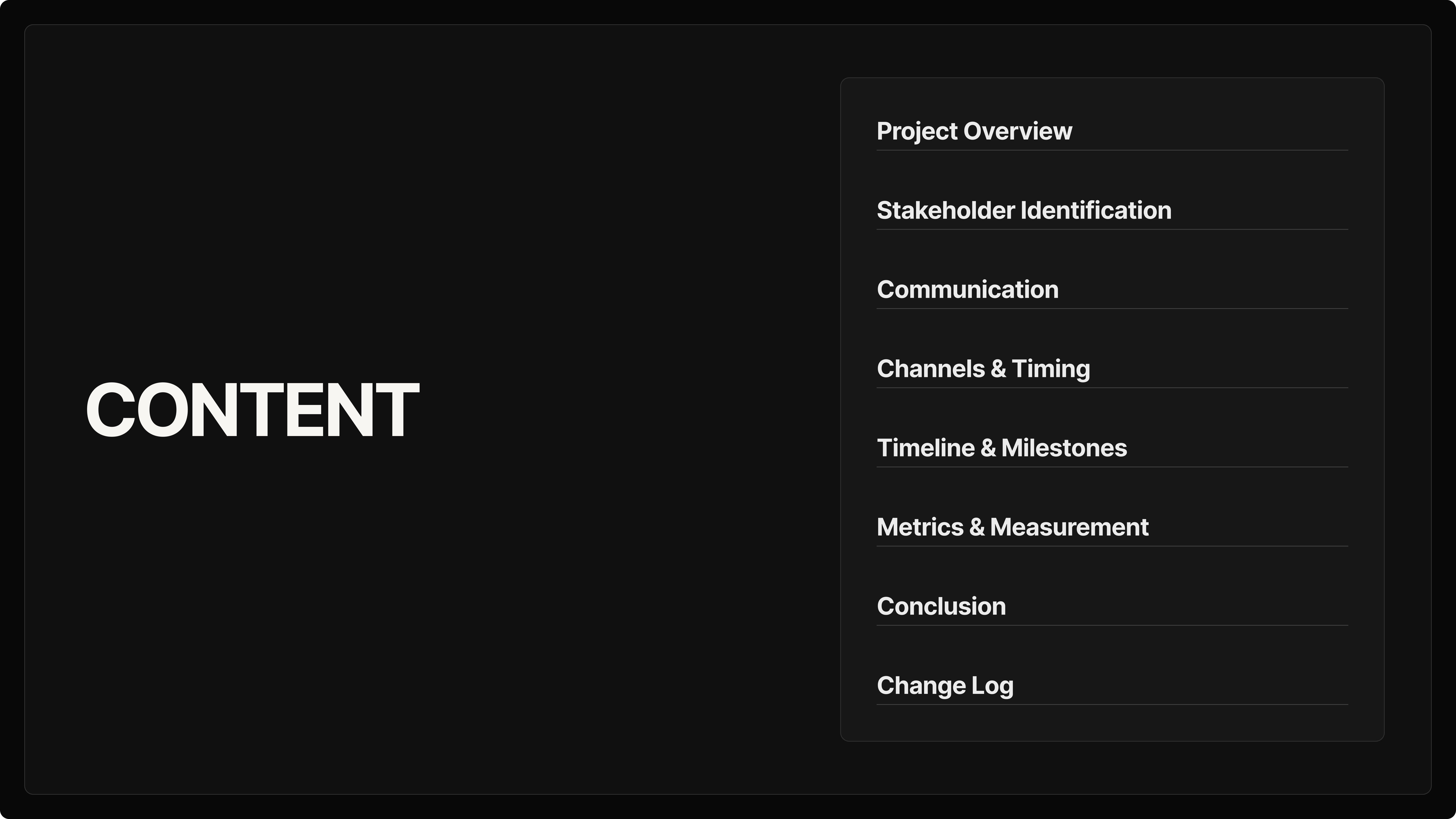
Table of Contents
The Challenge
When platforms launch payment features, poor stakeholder communication leads to:
- Low adoption: "I didn't know this existed"
- Trust erosion: "I have to pay for this now?"
- High support burden: "I don't know how to use this"
- Missed revenue potential
As a solo founder, I also face additional constraints:
- Limited time for communication activities
- Bootstrap budget (can't hire a team)
- No team to delegate to
The Approach
Rather than create a fictional scenario, I applied the communication framework to my real startup.
I defined 6 key stakeholder groups with distinct needs, created a phase-based communication strategy that rolls out over 6 months, and established clear success metrics to track progress.
The plan is optimized for solo-founder constraints by focusing on async communication channels like email and social media, methods of communication that don't require constant visibility, and applying automation where possible (triggered emails for example).
Phase 2 will trigger when:
- Plan triggers when Garden reaches 1000+ creators
- <5% monthly churn (stable product)
- Clear demand for payments
The Outcome
A ready-to-execute communication plan that drives adoption and builds trust through transparent and consistent messaging, minimizes support through education, and adapts corporate PM practices to my solo-founder startup reality without burning one out.
How to Read This Brief
Timeline is relative to activation ("Month 1" = when we decide to proceed with Phase 2), stakeholders are defined by role, not specific names (many don't exist yet), and the plan is lean and action-focused, designed for a bootstrap solo-founder reality.
In this body of text I will share the slide and my thought process behind it right after, within the link you will be able to access the prototype file without the extra explanation, that is, the actual communication plan.
Building In Public
This is a real plan for a real business. It's not perfect. It's not set in stone. It's a living document. It will evolve based on experience and feedback. As it evolves, the change log will keep track of changes.
At the end, you will find the challenges I've faced, acknowledgments to the people and resources that inspired and helped me complete this plan, the tools I used, and the change log.
Let's Begin
I will break the project apart but through the link you can access the single file without the extra explanations on each section.
Explanations will be added after each visual as required.
Introduction & Purpose

This first section goes over key information regarding the stakeholder communication plan such as its purpose, key objectives, and when it will be put into action compared to where we currently are.
Stakeholder Identification & Prioritization
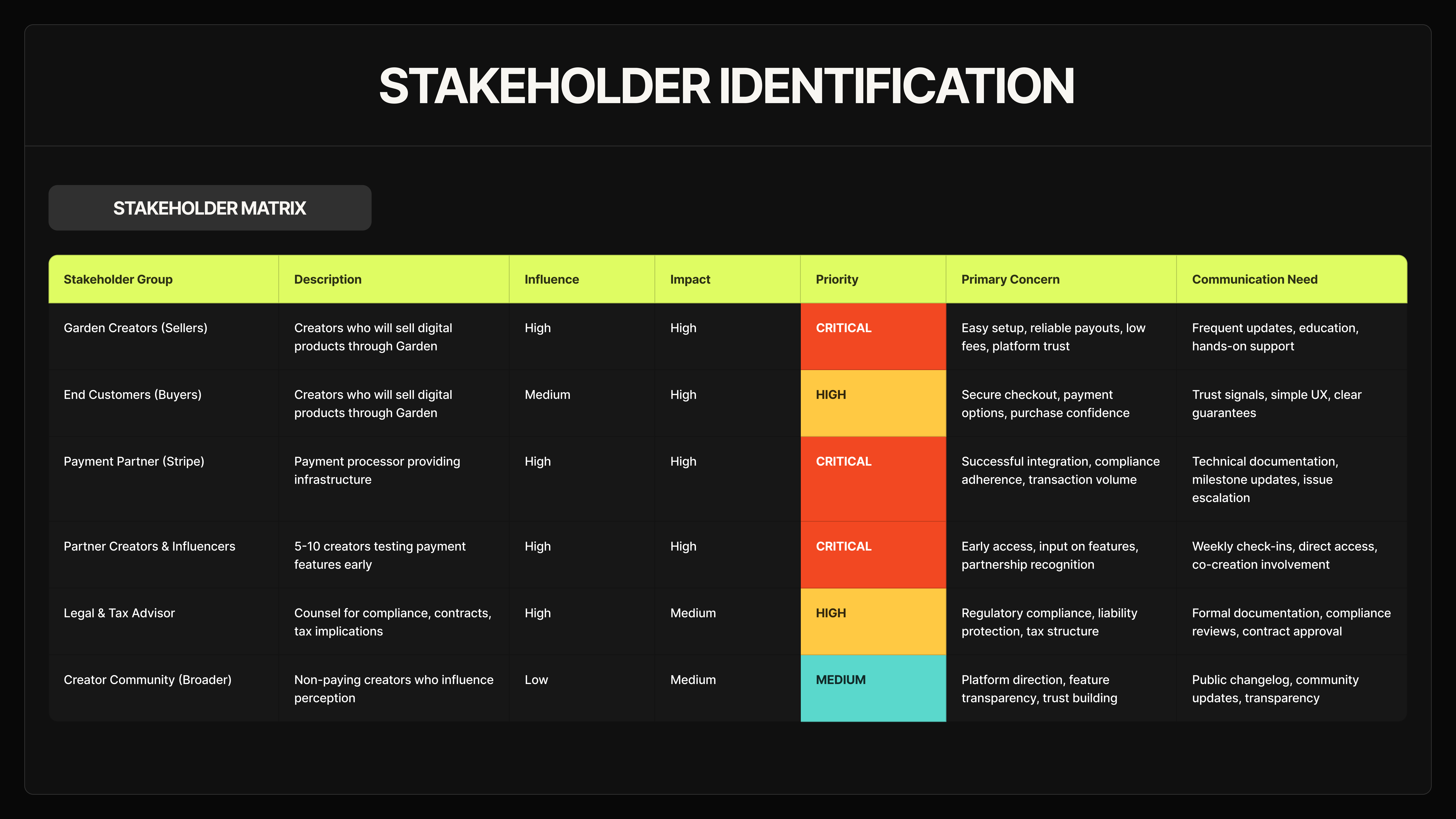
Mapping Approach
Stakeholders are prioritized using an Influence-Impact matrix.
- Influence = their ability to affect project success.
- Impact = how significantly the payment feature affects them.
This determines communication intensity and frequency.
Influence/Impact Grid
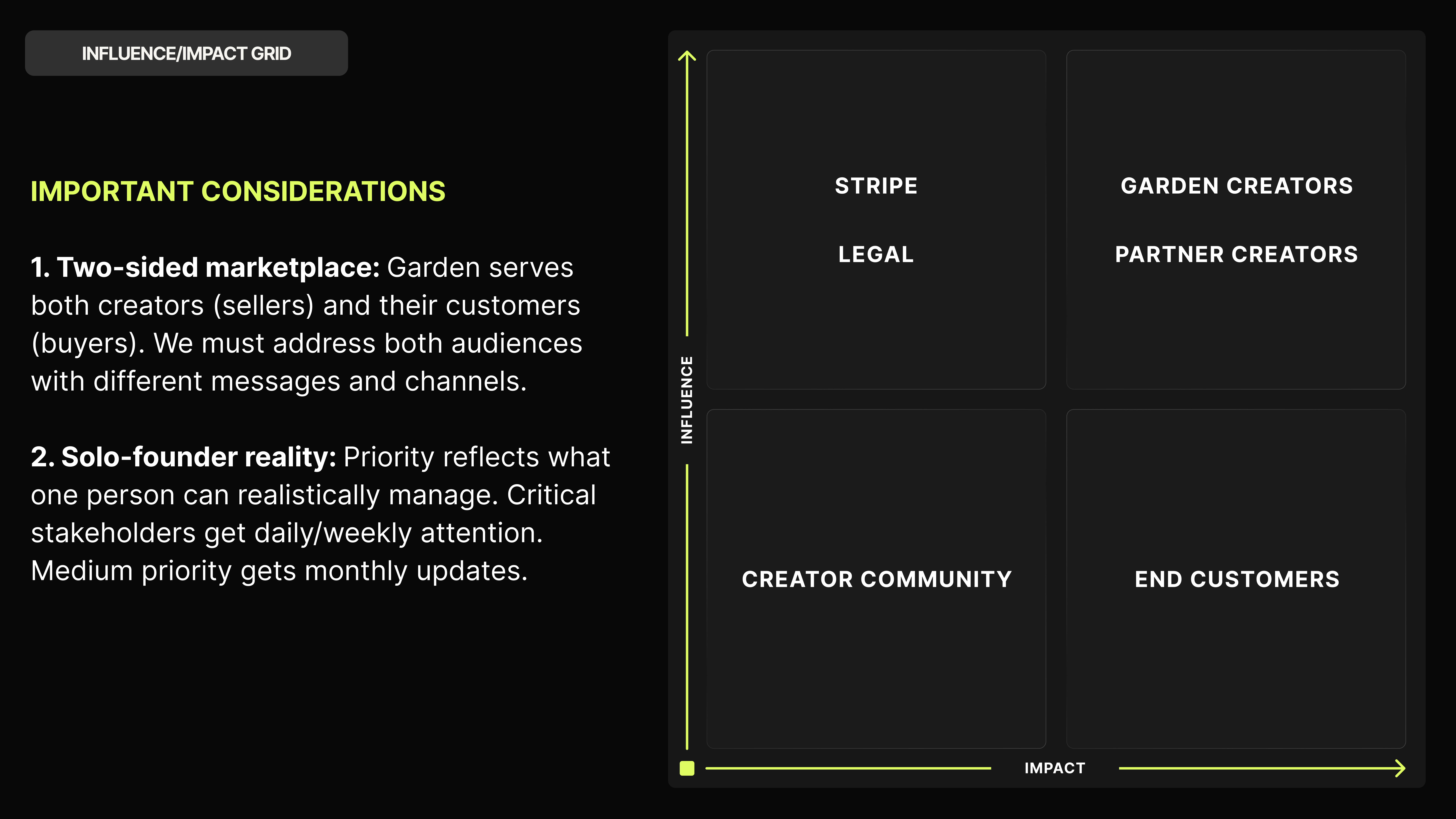
Grid Explanation
- Top Right = CRITICAL: Manage closely, high-touch communication
- Bottom Right = HIGH: Keep satisfied, regular updates
- Top Left = MEDIUM: Keep informed, periodic updates
- Bottom Left = MONITOR: Minimal communication, as needed
Identification & Prioritization Rationale
1. Garden Creators
- Why: They ARE your product. If they don't adopt, the feature fails.
- Communication: Weekly check-ins, constant feedback loop.
- Their concern: "Is this easy? Will I get paid? Can I trust this?"
- Our job: Make them feel supported, heard, and confident.
2. End Customers
- Why: Important for success, but less direct influence on decisions.
- They don't decide if I build it, but they decide if it succeeds.
- Communication: Indirect (UX, trust signals, support) not outreach.
- Their concern: "Is this safe? Will I get what I paid for?"
3. Stripe:
- Why: Technical dependency. If integration fails, everything fails.
- They have power: Can impose limits, require compliance work.
- Communication: Professional, proactive, compliance-first.
- Their concern: "Is he legit? Will he follow rules? What's our risk?"
4. Partner Creators
- Why: These are my testers, testimonials, and early advocates.
- Higher influence because they shape the initial experience.
- Communication: Weekly calls, direct access to you.
- Their concern: "Is my feedback implemented? What is in it for me?"
5. Legal/Tax
- Why: Helps with legality, but doesn't affect day-to-day execution
- Communication approach: Episodic (as needed) not continuous.
- Their concern: "Are we protected? Is this compliant?
6. Community
- Why: Influence perception but no direct impact on initial launch.
- Communication: Public, transparent, async (e.g. social media).
- Their concern: "Is Garden heading in the right direction? Should I invest time in this platform?"
Communication Strategy

Hierarchy & Tone
1. Creators (Primary Audience):
- Benefit first: "Monetize your audience" > "We're adding payments"
- Address friction: "10 minutes, no coding" = removes technical fear
- Build trust: "95% revenue kept" = transparent, fair pricing
- Create confidence: "We handle compliance" = remove burden
2. Buyers (Secondary Audience):
- Safety first: "Secure payment powered by Stripe" = borrow trust
- Emphasize simplicity: "Instant access" = no waiting, no hassle
- Provide backup: "Money-back guarantee" = risk removal
3. Stripe (Partnership Tone):
- Professional and prepared: "Clear timeline" = we're organized
- Compliance-aware: We understand the rules and will follow them
- Growth-oriented: This is good business for both of us
4. Design Partners (Co-creation Tone):
- Inclusive language: "With us" not "for us"
- Value their input: "Your feedback matters" = building with them
- Recognition: "Founding partner" = status and appreciation
5. Legal (Risk-mitigation Tone):
- Proactive: "Early guidance" = not last-minute thought
- Clear: "All documentation" = nothing hidden
- Realistic: "Clear timeline" = respect for their process
6. Community (Transparency Tone):
- Open communication: "Transparent roadmap"
- Responsive: "You asked, we're building"
- Quality over speed: Shows thoughtfulness, not rush
Channels & Timing
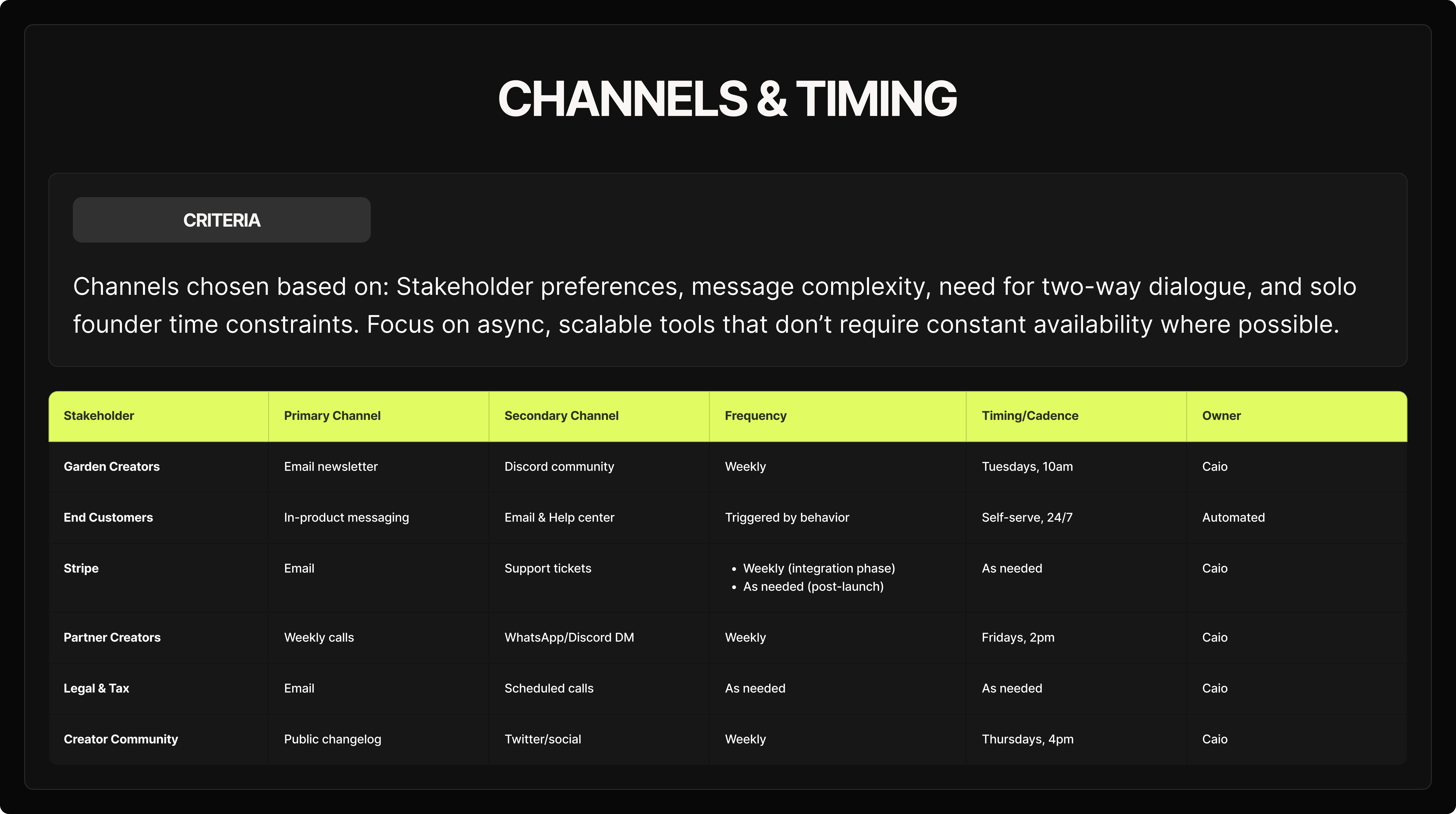
Channel Rationale
- Email as primary: Professional, creates record, high open rates with engaged audiences, allows links and longer-form content.
- Discord/Community: Async support, scales without time commitment, builds creator relationships, peer-to-peer help.
- Loom for updates: "Show, don't just tell." Personal touch at scale. Creators can watch on their schedule and on demand.
- Weekly partner calls: Relationship building. Real-time feedback. Catches issues early.
- Public changelog: Transparency builds trust. One update reaches everyone. Shows momentum.
Timeline & Milestones

As a founder and product professional, I would say that it's too early to confirm this as the final project timeline. A lot that could happen between here and there but, for the purposes of this brief, it's a start.
Metrics & Measurement

Conclusion
Challenges Faced
Balancing a real project with brief requirements:
It was hard deciding on staying true to Garden while looking for a way to meet brief expectations of a payment gateway launch play. Again, doing something for a potential phase 2 while I'm still in 1 was hard.
Thinking strategically about something that doesn't exist yet
Planning Phase 2 for a Phase 1 product required abstract thinking. I had to imagine stakeholder dynamics, estimate realistic metrics, and plan for future scenarios, all while keeping it grounded and practical.
Avoiding corporate bloat as a solo founder
Most stakeholder communication plan examples come from large companies with teams, budgets, and processes I don't have. The challenge was adapting these frameworks to my solo-founder reality.
Working With AI
AI can be an incredible thinking partner, but only if you know how to use it critically. You need to understand prompting, recognize when it's losing context, and know it doesn't read minds.
My background in AI was extremely helpful here. Knowing how to course-correct, provide clear context, and demand critical thinking rather than yes-man responses.
Without that understanding, working with AI doesn't save time; it creates more work cleaning up mediocre outputs that sound good but miss the mark. The tool is only as good as how you use it.
Acknowledgements
Uxcel for creating a brief to push me to learn and do something I have never thought about before. I got more clarity on my business now.
Jonas Broms for inspiring my project covers.
Alesya Dzenga for your tutorial on posting my first brief.
Colin Michael Pace for your course on ChatGPT and the lesson on Stakeholder Communication
ProjectManager.com for teaching a bit more on stakeholder communication plans.
Tools Used
- TypingMind as an AI interface where I can run models locally and thus keep my business data private.
- Claude as my first "employee" and thinking partner. Fun fact: This project costed me $14 in tokens.
- The internet as an infinite source of knowledge.
- Figma for designing the final version.
Change Log
Version 1.0 - December 21, 2025
- Initial creation for Uxcel brief.
- Based on Phase 2 planning assumptions.
Future updates will reflect real learnings as Garden grows.
Tools used
From brief

Topics
Share
Reviews
3 reviews

This is an outstanding piece of work. What I really appreciate is that this isn’t a fictional scenario; it’s a real, living plan for a real product, and that shows in every decision you made.
Your stakeholder identification and prioritization are very thoughtful and realistic, especially in the context of a solo founder.
What stands out most is your reflection. The way you describe challenges, trade-offs, and even the limits of working with AI shows strong product maturity and self-awareness. This goes far beyond the brief and feels like something you could actually execute tomorrow.

I really loved the way you translated the product vision for the stakeholders — it was very well done. I definitely plan to use this as a reference for my future presentations.

Solid job, well-thought plan that feels very real and doable. Stakeholders and messaging are pretty clear a bit more focus on metrics and decision moments would make it even sharper
You might also like

Smartwatch Design for Messenger App


Bridge: UI/UX Rebrand of a Blockchain SCM Product


Pulse Music App - Light/Dark Mode


Monetization Strategy


Designing A Better Co-Working Experience Through CJM


Design a Settings Page for Mobile
Design Leadership Courses

UX Design Foundations

Introduction to Figma
Introduction to Design Systems