Defining the Product Strategy
Craft product strategy by transforming customer and market insights into focused competitive choices
Product strategy is your integrated set of choices that define where you'll compete and how you'll win. It's not a plan, a goal, or an ambition. It's the deliberate decisions about which customers to serve, what value to create, and which trade-offs to make. A strong product strategy creates focus by explicitly defining what you won't do, enabling teams to move forward with clarity and confidence.
Strategy emerges through discovery — it requires understanding your market segments, identifying unmet customer needs, and making deliberate choices about competitive positioning. Your strategy should explain why customers will choose your product over alternatives and what makes it difficult for competitors to copy your approach. The components work together as a system. Your target customers, value proposition, capabilities, and growth channels must reinforce each other. When these elements align, they create sustainable competitive advantage and guide every product decision from features to pricing.
Product strategy consists of interconnected choices that define how your product will succeed. At its core, strategy must articulate your winning aspiration, the vision that inspires your team and guides decisions. This vision connects to specific market segments where you'll compete and the problems you'll address.
A complete strategy defines your
Your strategy should pass the “can't or won't” test, meaning competitors either can't replicate your approach due to technical barriers, or won't because it conflicts with their existing model. Your key metrics should track whether your strategic choices are working and creating the intended customer value.[1]
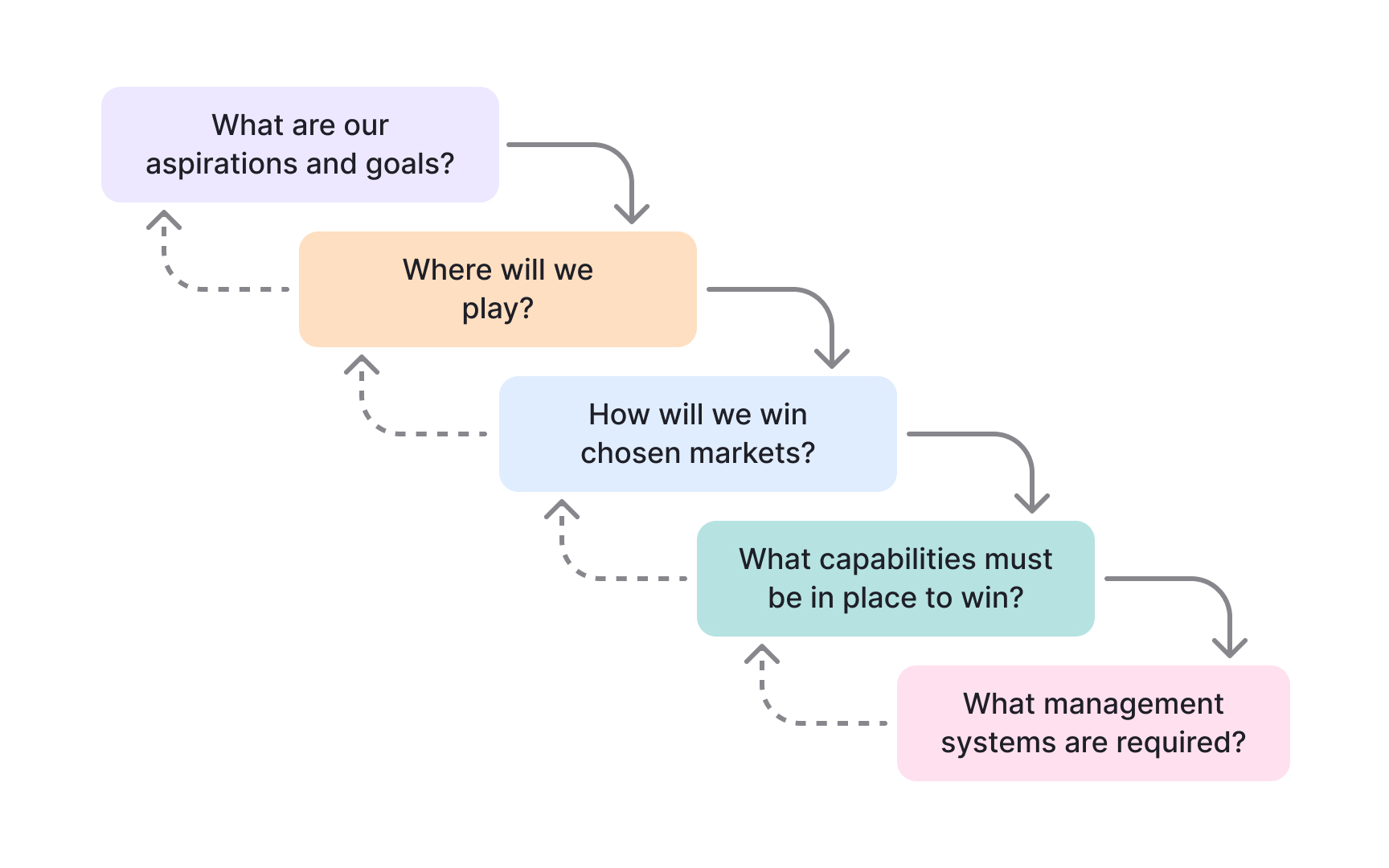
Strategy frameworks provide structured approaches to making strategic choices, though no single framework fits every situation:
- The Playing to Win framework emphasizes 5 cascading choices: winning aspiration, where to play, how to win, capabilities to build, and management systems to support execution. This approach ensures strategic elements connect and reinforce each other.[2]
- Porter's Five Forces analyzes competitive dynamics by examining supplier power, buyer power, competitive rivalry, threat of substitutes, and threat of new entrants. This helps identify market attractiveness and defensive positions.[3]
- The Blue Ocean Strategy focuses on creating uncontested market space by simultaneously pursuing differentiation and low cost, making competition irrelevant.[4]
Different frameworks serve different purposes. The key is recognizing patterns across frameworks rather than rigidly following templates. Effective strategists combine insights from multiple frameworks, adapting them to their specific context and extracting relevant questions that drive strategic thinking.
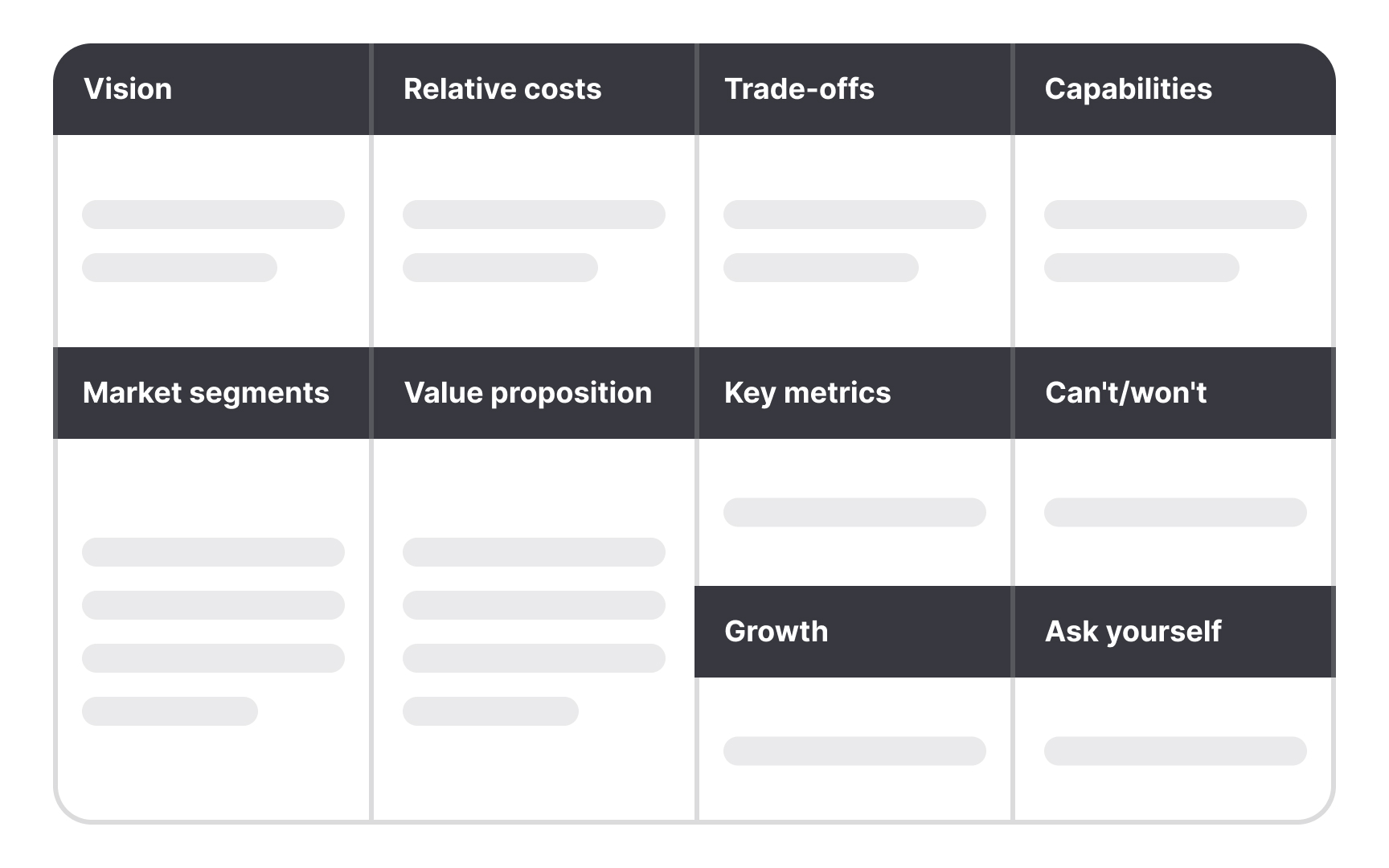
The Product Strategy Canvas Paweł Huryn provides a structured template for documenting strategic choices in one place. It captures vision, market segments,
This single-page format makes strategy accessible and facilitates alignment conversations across teams:
- Market segments identify customer groups with shared jobs to be done, including geographic or language constraints, helping you choose your first target segment
- Relative costs clarify whether you optimize for low cost like Ryan Air or unique value like Starbucks
- Value proposition captures four elements for each segment: the problematic before state, how your features change the situation, the after state with benefits achieved, and your unique advantages versus alternatives
- Trade-offs define what you won't do, like IKEA refusing to sell assembled furniture, creating focus that amplifies value
- Key metrics measure whether your strategy works, using approaches like the North Star Metric
- Growth specifies whether you'll pursue product-led or sales-led approaches and which channels like SEO, social media, or resellers you'll prioritize
- Capabilities identify competencies, resources, suppliers, or partners you need
- Can't or won't explains why competitors can't or won't copy your strategy through unique technology, culture, or partnerships
- Ask yourself tests whether elements reinforce each other and identifies assumptions needing validation[5]
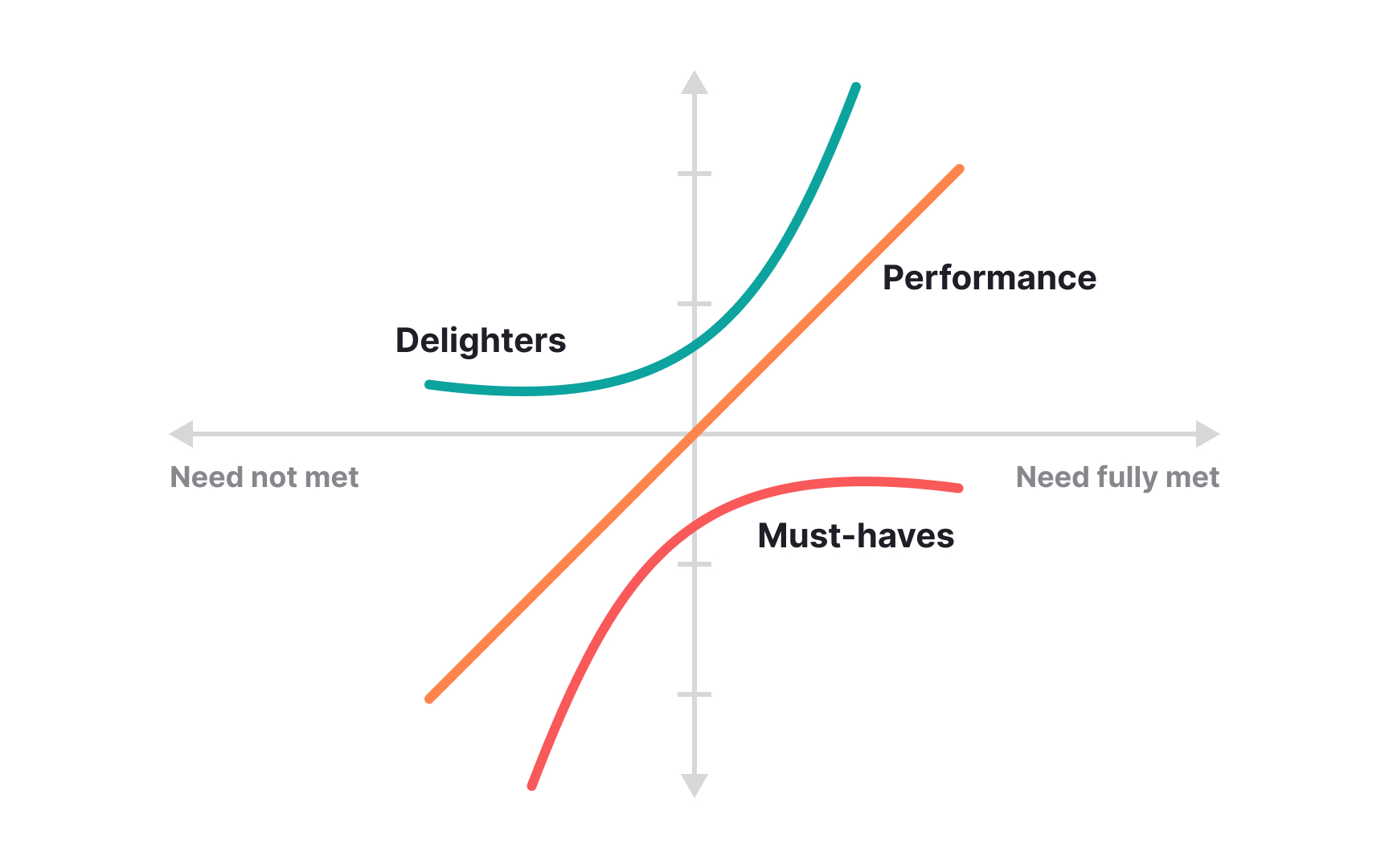
The Kano model classifies features into 3 categories based on how they affect customer satisfaction:
- Must-have features are table stakes that customers expect. Their absence creates dissatisfaction, but their presence doesn't increase satisfaction.
- Performance features follow a linear relationship where better execution creates higher satisfaction.
- Delighters exceed customer expectations, creating disproportionate satisfaction even though their absence causes no dissatisfaction.[6]
Strategic product decisions require understanding which category each feature belongs to. Competing on must-haves wastes resources since all competitors provide them. Performance features offer differentiation opportunities when you can significantly outperform competitors on dimensions customers value. Delighters create the strongest competitive advantage because customers don't expect them, making them memorable and word-of-mouth worthy.
Remember, feature categorization shifts over time. Yesterday's delighters become today's performance features and tomorrow's must-haves as customer expectations evolve and competitors copy successful features. Instagram's filters were delighters in 2010 but became expected performance features by 2015. Your strategy must anticipate these shifts and continuously identify new performance and delighter opportunities.
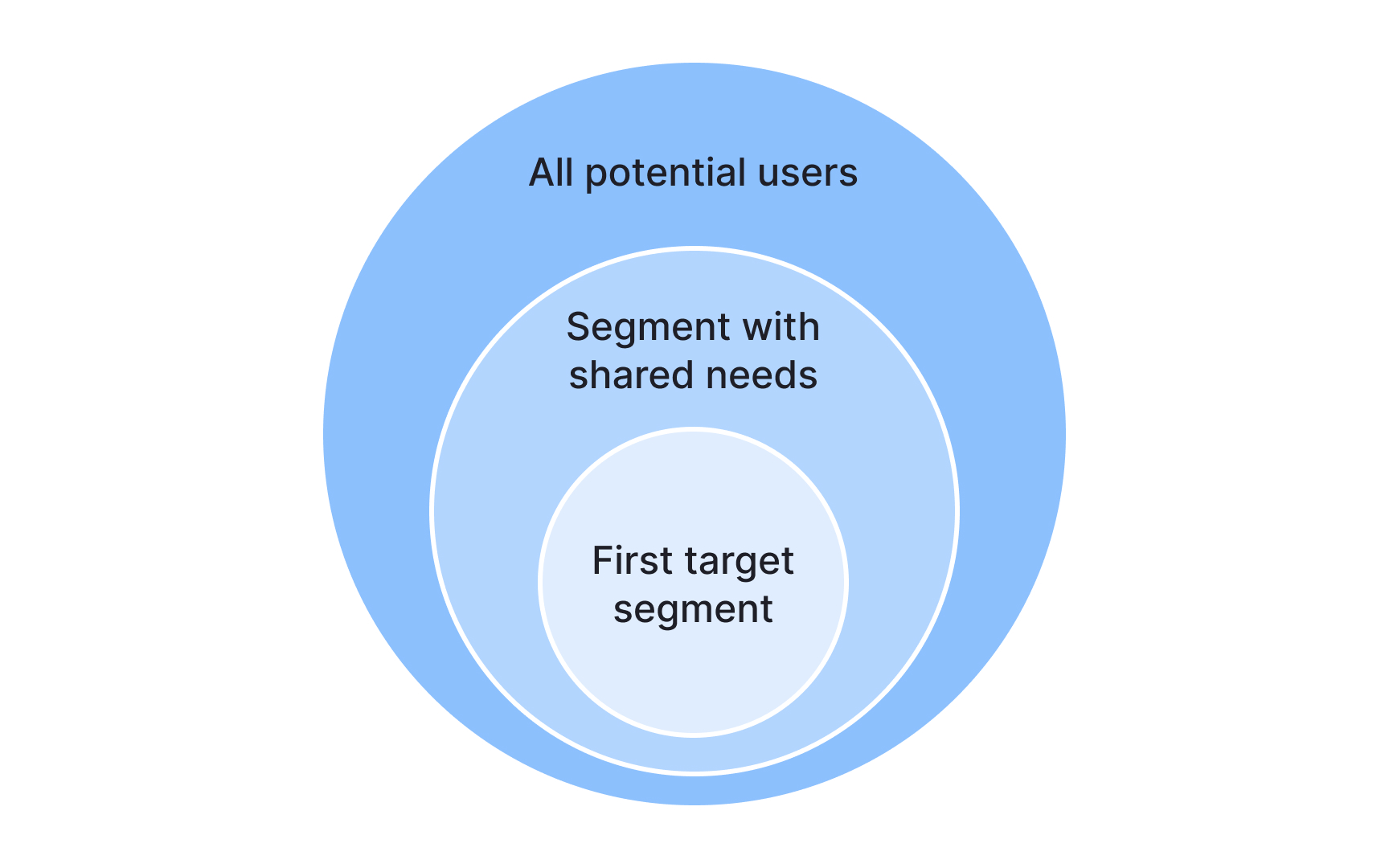
Target customers represent specific segments you'll serve exceptionally well rather than trying to satisfy everyone. Defining your target means identifying groups with shared problems, goals, and constraints. This focus lets you build deep expertise in their needs and create solutions competitors can't easily replicate across all segments.
Customer definition goes beyond demographics. It also includes what customers are trying to accomplish and the outcomes they seek. Market constraints like geography, language, regulations, or company size further refine your target. Within broader markets, segments emerge based on how important different needs are and how satisfied customers currently feel with existing solutions.
Starting with one primary segment lets you learn quickly and establish product-market fit before expanding. Instagram initially targeted iPhone users who wanted to share photos quickly, not all mobile phone users or all photography enthusiasts.[7] This narrow focus enabled them to optimize for that specific use case and build viral growth within that segment before broadening their scope.
Customer problems form the foundation of valuable products. Problems worth solving are important to customers, occur frequently enough to justify a solution, and remain inadequately addressed by existing alternatives. Problem importance varies across customer segments, making it essential to understand which problems matter most to your target customers.
Discovery methods help validate problem significance. Customer interviews reveal what tasks feel painful and which outcomes customers struggle to achieve. Observation shows actual behavior rather than reported behavior, often uncovering problems customers can't articulate. Social listening through forums and reviews exposes common frustrations and workarounds people have created.
Problems exist at different levels. Surface problems like slow software performance often mask deeper problems like inability to meet deadlines or losing competitive advantages. Effective strategy addresses underlying problems that create meaningful value rather than superficial symptoms.
Competitive differentiation defines how you'll win against alternatives. Differentiation isn't about being better at everything but rather about making deliberate choices about where to excel and where to accept being adequate or inferior.
3 differentiation paths exist:
- Cost leadership means delivering similar value at lower
prices through operational efficiency or business model innovation - Differentiation through unique value means providing capabilities competitors don't offer, justified by premium pricing
- Focus strategy means serving specific segments better than broad competitors by deeply understanding narrow customer needs
Sustainable differentiation requires barriers that prevent easy copying. These include proprietary technology, network effects, brand reputation, exclusive partnerships, or accumulated data advantages. Your differentiation must connect to capabilities you can build and defend while mattering enough to your target customers that they'll choose you despite other products' strengths.
Strategic focus areas define where you'll concentrate resources and attention. Focus creates competitive advantage by enabling depth rather than breadth. Teams that pursue too many priorities simultaneously spread resources thin and execute nothing excellently. Clear focus areas help everyone understand what matters most and what to deprioritize or stop doing.
Focus areas emerge from your strategic choices about target customers, problems to solve, and competitive differentiation. If you're pursuing cost leadership, focus areas might include automation and supply chain optimization. If you're differentiating through unique value, focus might shift to advanced technology capabilities or exceptional user experience. 3-5 focus areas typically represent the maximum a product organization can pursue effectively.
Each focus area requires specific capabilities, investments, and trade-offs. Declaring focus areas publicly creates accountability and helps resist pressure to add more priorities. Spotify's focus on personalized music discovery required investing heavily in recommendation algorithms and data infrastructure. This meant saying no to high-fidelity audio quality initially and forgoing music ownership models, trade-offs that enabled them to scale rapidly and differentiate through superior discovery while keeping costs manageable for freemium users.
B2B and B2C products require different strategic approaches despite sharing fundamental strategy patterns. B2B products involve multiple stakeholders including end users, champions who advocate internally, and buyers who control budgets. Strategy must address needs across these groups while recognizing longer sales cycles and higher switching costs. B2C products typically face individual decision-makers with shorter consideration periods and easier experimentation.
B2B strategies often emphasize relationship selling, customization capabilities, and integration with existing enterprise systems. Champions function like early adopters, helping validate concepts with executives and industry leaders before broader rollout. On the other hand, B2C strategies focus more on viral acquisition, network effects, and mass adoption.
Risk profiles differ significantly too. B2C companies can test positioning changes and pivot more easily since individual user decisions happen quickly. B2B pivots require longer validation cycles and organizational changes including sales team retraining and new partnerships. However, B2C products serving businesses often discover B2B expansion opportunities by packaging proven offerings for enterprise buyers, adding business-specific features like single sign-on or administrative controls.
Strategy documentation makes choices explicit, enables alignment, and creates accountability. Effective documentation balances comprehensiveness with accessibility. 2-3 sentence summaries help teams internalize strategy and use it in daily decisions without consulting lengthy documents. More detailed documentation provides rationale and context for those needing deeper understanding.
Your documentation should capture core strategic choices: target customer segments, problems you're solving,
Strategy documents are living artifacts, not static plans. Update them regularly based on what's working and what's not, using key metrics to guide revisions. Share strategy broadly across the organization so everyone from engineering to sales understands the strategic context for their work. This shared understanding enables autonomous decision-making aligned with strategic direction, the true test of whether documentation succeeds.
References
- Playing to Win: How Strategy Really Works | Farnam Street
- Porter's Five Forces Explained and How to Use the Model | Investopedia
- What is Blue Ocean Strategy | About Blue Ocean Strategy | Blue Ocean Strategy
- What is the Kano Model? Definition & Methodology | GrowthMentor
Topics
From Course

Share


Similar lessons

Continuous Discovery Mindset

Business Outcomes vs. Product Outcomes