Create a UX Research Survey

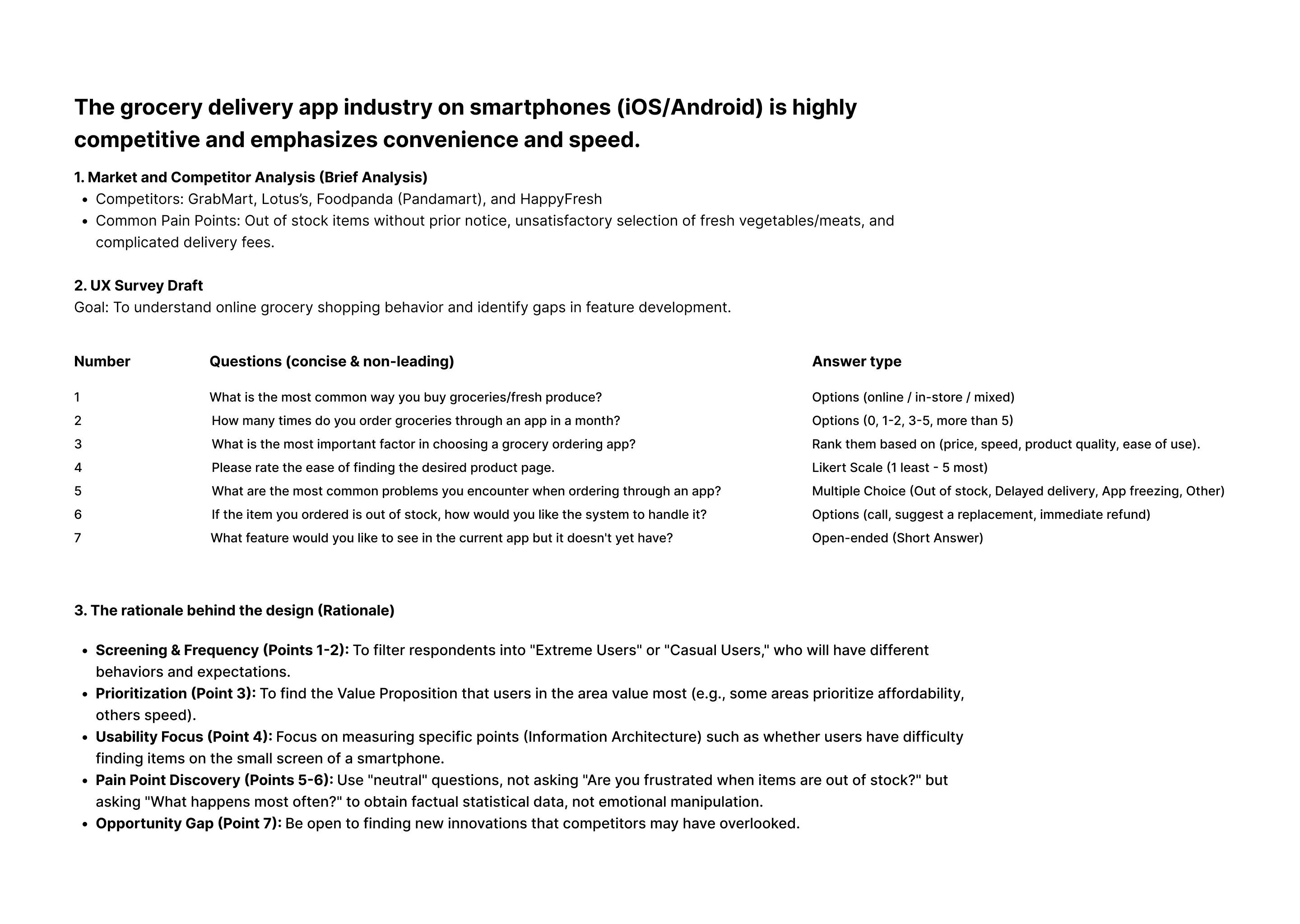
The grocery delivery app industry on smartphones (iOS/Android) is highly competitive and emphasizes convenience and speed.
Reviews
1 review

The UX research survey is very good. You’ve identified key, valid steps, and the structured questions paired with a clear rationale show strong design thinking. It allows you to build a product based on real behavioral patterns rather than assumptions.
Here are my recommendations to improve the survey:
- Define the Goal and Audience: Before launching, think about the final endpoint. Since the goal is creating User Personas, you need to be very specific about identifying who these end-users are. Decide exactly who you will survey and where you will find them to ensure your data isn't biased.
- Avoid Leading or Closed Questions: Question 3 ("What is the most important factor...") is a bit too restrictive. By offering only "price, speed, and quality," you are imposing options on the user. I recommend making this less straightforward, add an "Other" option or ask it as an open-ended question to see what actually matters to them.
- Contextualize the Behavior: Before asking why they choose an app, you need to understand if they even use one. It’s valuable to ask "Why do you buy in-store vs. in-app?" to understand the friction points of the digital experience compared to the physical one.
- Behavior vs. System Thinking: Users are not designers or developers; they shouldn't have to think about how a system "handles" a problem like out-of-stock items (Question 6). Instead of asking for a system solution, ask about their emotional and behavioral response: "Have you experienced an item being unavailable? What did you do next?" This helps you understand their "pains" rather than asking them to design the "features" for you.
- Cognitive Load in Questions 5-6: These questions are currently a bit complicated and force the user to think about the app's internal logic. To get more honest data, keep the focus on their experience and feelings in the moment of frustration.
- Prioritization Criteria: For your rationale on prioritization, I’d like to see the specific actions or criteria you will use to decide which pain points are the most urgent to solve.
Once you have this data, how will you distinguish between a "Casual User" and an "Extreme User" when building your personas?
4 Claps
Average 4.0 by 1 person
You might also like

Project
Improving Dating App Onboarding: A/B Test Design
This project explores how improving the onboarding experience of a dating app can increase profile completion and early user engagement. I d

Project
FORM Checkout Flow - Mobile

Try out the prototype here. Design Rationale Why mobile? Mobile accounts for the majority of e-commerce browsing, and premium furniture pur

Project
A/B Test for Hinge's Onboarding Flow

This project focuses on improving the onboarding experience of a dating app - Hinge, by addressing low profile completion rates. Since profi

Project
Accessibility Asse

For this project, the LearnLink website was selected, and the goal was to redesign the login and sign-up pages specifically, adapting them t

Project
The Fitness Growth Engine

This slide shows how user behavior translates into business success by connecting activation, habit formation, retention, and monetization i

Project
The Relational Workspace

Over four years, I led the design evolution of a high-stakes education platform, transforming a fragmented messaging app into a cohesive Stu
User Research Courses

Course
Ethical & Responsible Product Design

Learn to build products that respect users, society, and the planet while driving sustainable business growth

Course
The Product Development Lifecycle & Methodologies

Learn the full product development lifecycle: from validating ideas and defining strategy to designing MVPs, testing with users, and launching products that hold up over time.

Course
Writing Effective Product Specs

Learn to write clear, structured product specs that align teams, prevent miscommunication, and guide products from concept to successful release.