Leading Through Change and Sustaining Collaboration
Guide stakeholders through uncertainty with clear communication, steady support, and shared ownership.
Periods of change often unsettle teams. Priorities shift, routines break, and expectations become harder to read. In these moments, strong collaboration depends on clarity, trust, and a steady hand. When people understand what is changing, why it matters, and how they are supported, they stay engaged instead of withdrawing or resisting.
Change management frameworks highlight the importance of aligning communication, addressing emotional reactions, and sustaining participation over time. Continuous communication keeps people informed, while tailored messages respect different concerns and levels of influence. Visible leadership commitment shows that the effort is real, not a passing idea. Quick wins, feedback loops, and training reinforce progress so that teams do not lose momentum.
Collaboration is easier to maintain when stakeholders feel included, listened to, and empowered to participate. This lesson connects stakeholder management practices with established change-management principles to help teams move through uncertainty with confidence.
Change management helps organizations guide people through transitions in a structured way. It focuses on how individuals react to new processes, systems, or responsibilities and what support they need to adjust. When people understand the reason behind a change, receive clear communication, and get the right level of training, they can adopt new behaviors more confidently. This increases the speed of adoption, raises the number of people who use the new solution, and improves their proficiency. These outcomes lead to better project results and stronger return on investment.
Without a structured approach, even well-designed changes struggle to succeed. Projects may fall behind schedule, teams may stay attached to old habits, or people may feel disconnected from the purpose of the change. A clear change management process reduces these risks by helping organizations plan communication, involve the right roles, and prepare people for what is coming. This preparation makes transitions smoother and helps organizations respond more effectively to evolving needs.[1]
When organizations move through change, stakeholders do not react at the same pace. Some feel shock or denial, others respond with anger or bargaining, and some eventually move toward acceptance. These emotional stages influence how people show up in conversations and how willing they are to share information or support decisions. Understanding these shifts helps teams anticipate dips in motivation instead of misreading them as a lack of interest or effort.
These reactions also affect how well stakeholders work together. During the early stages, collaboration can slow down because individuals focus on processing their own uncertainty. Tension may rise when people feel their routines or relationships are disrupted. As acceptance grows, teamwork becomes more stable again and people begin to reconnect with shared goals. Recognizing these patterns gives teams a clearer sense of what is happening and helps prevent misunderstandings during difficult moments.[2]
Pro Tip: When collaboration slows, check whether people are reacting to the change rather than to each other.
Clear and consistent communication helps teams stay aligned when processes or priorities shift. People need messages that reduce confusion and explain what is happening in a simple and timely way. Using different channels such as email, meetings, digital platforms, or town halls helps ensure that all groups receive information in formats that suit their needs. A steady rhythm of updates prevents silence from becoming a source of stress or speculation.
Communication during change works best when messages speak to the concerns of specific groups. Executives may look for strategic impacts, while frontline teams often care about how the change affects daily work. Keeping the core message stable while adapting framing for different audiences helps maintain trust. When communication remains open and continuous, teams are more likely to stay engaged and less likely to misinterpret the situation.[3]
Pro Tip: Use multiple channels, so updates reach everyone without relying on a single communication method.
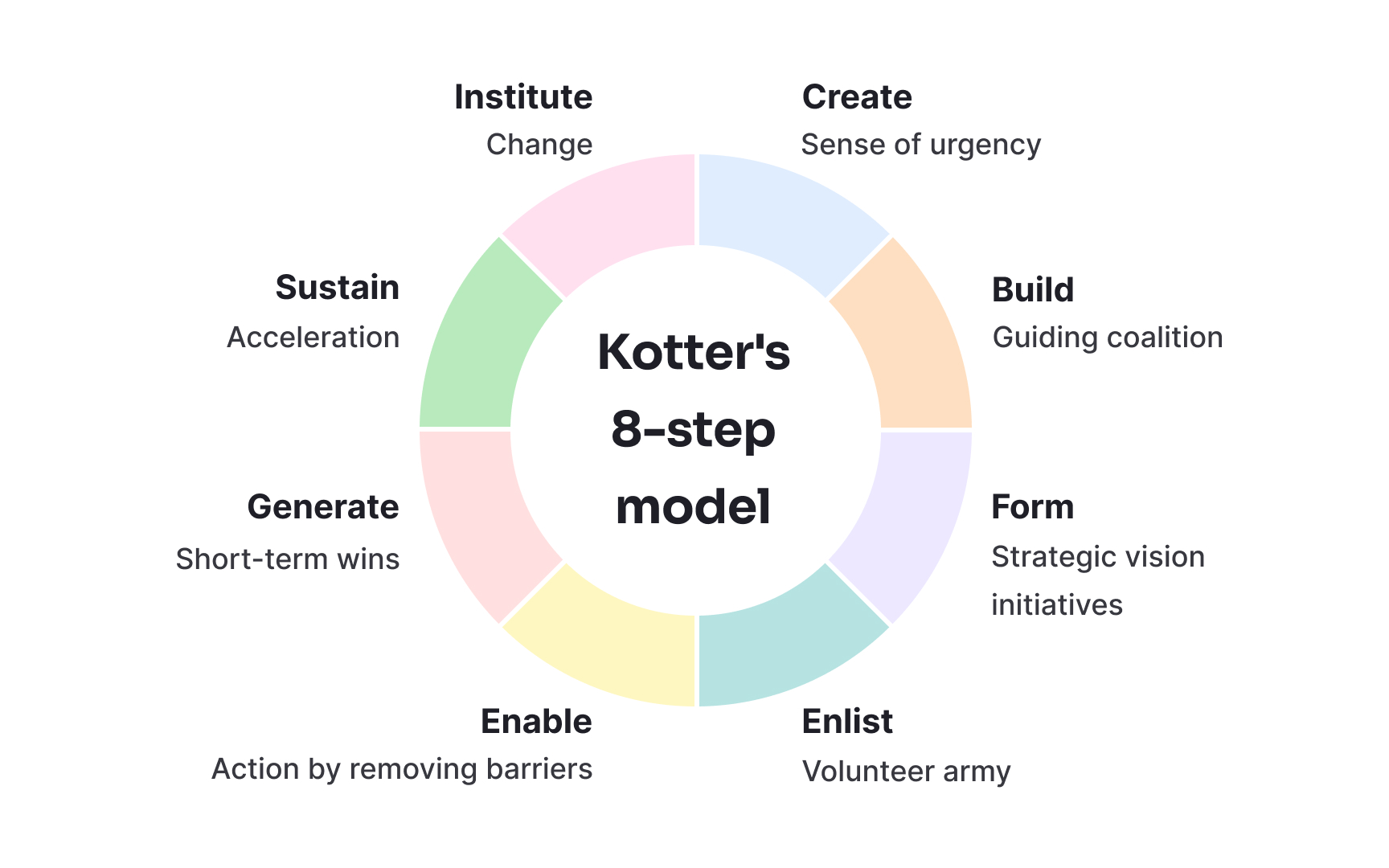
The Kotter model is a structured framework that helps organizations manage major transformations with more clarity and direction. Its goal is to guide teams through change in a way that reduces confusion, builds momentum, and turns new practices into long-term habits. The model was developed by John P. Kotter after studying many companies that struggled with change. His research showed that organizations succeed more often when they follow a clear sequence instead of acting in an unplanned or reactive way.
The model is built around 8 steps that connect people, communication, and action. These steps include:
- Creating urgency
- Forming a guiding coalition
- Shaping a clear vision
- Communicating that vision
- Removing obstacles
- Generating short-term wins
- Building on improvements
- Anchoring changes in the culture
Each step supports the next one, and together they create a path that helps teams move from early uncertainty to stable adoption. Because the model focuses on both strategy and human behavior, it helps organizations manage change in a more predictable and collaborative way.[4]
The Kotter model is implemented by following each step in order so teams can move through change with clarity, shared direction, and steady momentum. The list below explains the purpose of each step and how it supports a smooth transition and collaboration:
- Create urgency. Help people understand why the change is necessary right now. This often includes sharing data about risks, competitor pressure, or missed opportunities so teams feel motivated to act.
- Build a guiding coalition. Bring together individuals with authority, credibility, and relevant expertise. This group leads the effort, keeps attention on the change, and helps others stay aligned.
- Form a strategic vision. Describe the desired future state and how the organization will benefit from the change. A clear vision gives people direction and helps them understand why the work matters.
- Communicate the vision. Share the vision frequently and across different channels such as meetings, digital platforms, and internal updates. Regular communication keeps the message present in daily work.
- Remove obstacles. Identify and address barriers that slow progress. These may include outdated processes, unclear responsibilities, or missing resources. Removing obstacles helps people act with confidence.
- Generate short-term wins. Create early achievements that are visible and meaningful. These wins show that the change is working and help maintain motivation during longer transitions.
- Build on the change. Use early wins as a base for further progress. Continue refining processes, expanding improvements, and preventing the organization from slipping back into old habits.
- Anchor the change in culture. Integrate new behaviors and practices into everyday routines. When these behaviors become part of the culture, the change is more likely to last over time.
Pro Tip: Keep short-term wins visible. They reinforce progress and help stakeholders stay committed.
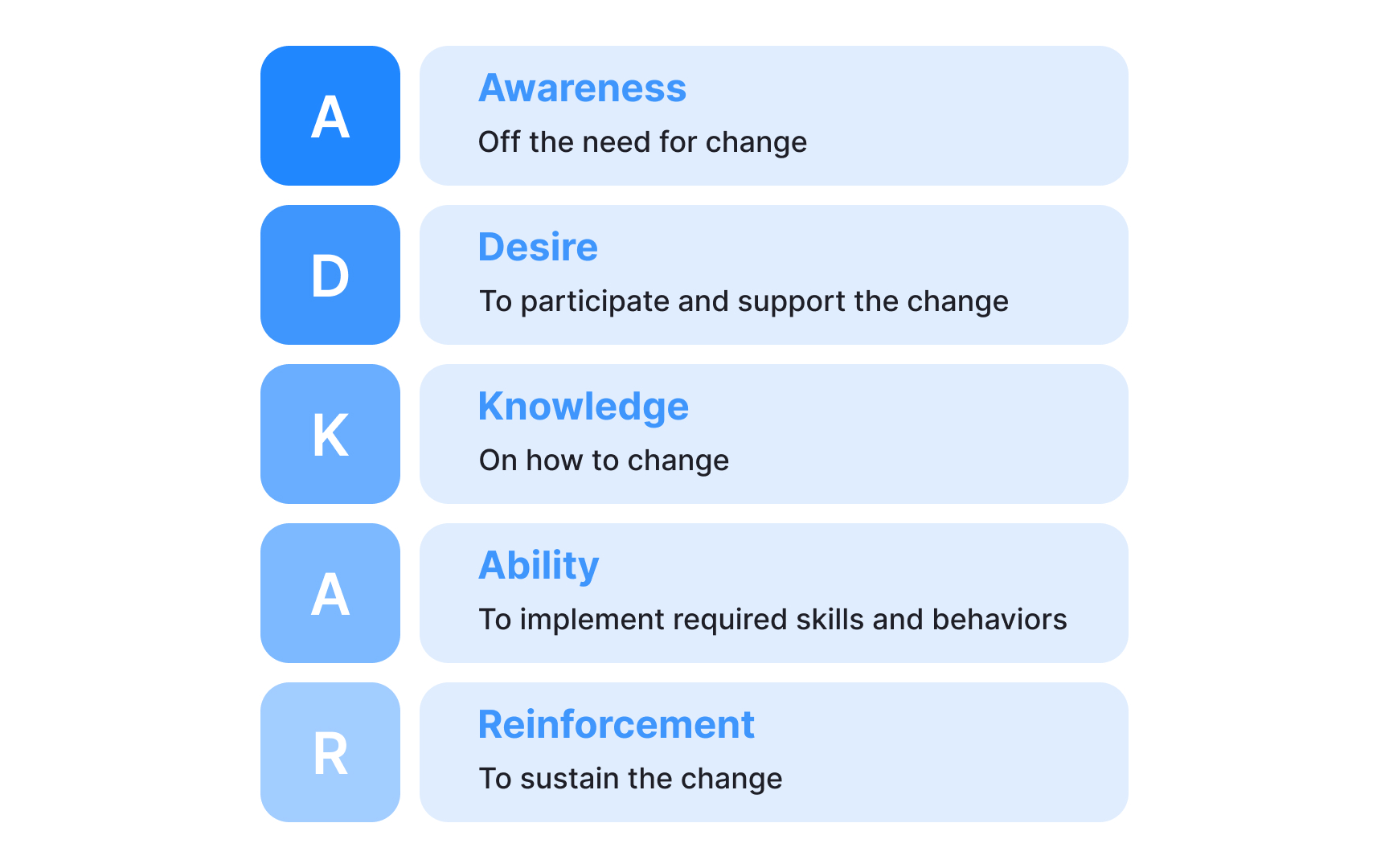
The ADKAR model describes 5 building blocks that help individuals move through change. It focuses on what people need at a personal level so they can adopt new behaviors with clarity and confidence. The model includes:
- Awareness, which helps people understand why the change is happening. When awareness is missing, individuals often feel uncertain or disconnected from the purpose of the transition.
- Desire, which reflects a person’s willingness to participate. This step depends on how the change affects them, how much they trust leadership, and whether they see value in the new direction.
- Knowledge, which includes the information and training people need to perform in the new state. Even motivated individuals struggle when they do not know what to do or how to do it.
- Ability, which focuses on building the skills and practical experience needed to apply the change in daily work.
- Reinforcement, which ensures that new behaviors stay in place over time. This can include recognition, support from managers, or systems that encourage consistent practice.
When all 5 elements work together, individuals are more likely to adopt and sustain the change.[5]
Pro Tip: Use ADKAR as a checklist to understand whether resistance comes from missing awareness, desire, knowledge, ability, or reinforcement.
ADKAR helps teams understand why people may struggle during a change and what kind of support they need. When awareness is low, stakeholders often feel unsure about why the change is happening. Simple and early communication helps them see the purpose and reduces confusion. If desire is low, people may not feel motivated to join the change. Leaders can improve this by explaining how the change benefits both the organization and the individual, or by listening to concerns that make participation difficult.
Knowledge and ability also shape how people react. Stakeholders may resist if they do not know what to do or if the new tasks feel too challenging. Clear instructions, training, and guided practice help them feel more prepared. Reinforcement keeps people engaged after the initial rollout. When progress is recognized and supported, new behaviors are more likely to stick. ADKAR gives managers a simple way to understand where stakeholders are getting stuck and what actions can help them move forward.
Collaboration is easier to maintain when communication stays active throughout the entire change process. Regular updates help people understand what is happening, what has progressed, and what still needs attention. When information flows consistently, teams feel less uncertain and more connected to the work. Sharing updates through different channels, such as meetings,
Feedback plays an important role in long-term collaboration. When teams have simple ways to raise questions, share concerns, or suggest improvements, they feel included in the transition instead of being passive observers. This feedback can come from pulse surveys, check-ins, or open discussions. Listening to these signals helps organizations adjust their plans and respond to new needs that appear during the change. Closing the feedback loop by explaining what was heard and what actions were taken strengthens trust and keeps people engaged over time.
Pro Tip: Share updates before people start asking for them. It builds trust and keeps collaboration steady.
Stakeholders stay more engaged when leadership involvement feels real and consistent. Support is stronger when leaders show that they are part of the change rather than observing it from a distance. This includes taking part in meetings, speaking openly about progress, and showing how they are adapting their own work. When people see this behavior, they feel more confident that the change is a shared effort and not something being imposed without accountability. Visible commitment also reduces doubts about whether the initiative will last or fade away.
Leadership presence also helps teams stay grounded when the change becomes challenging. People naturally look to leaders to understand whether they should trust the direction and continue investing their effort. When leaders remain active and approachable, it creates a sense of stability that makes collaboration easier. Stakeholders feel safer raising concerns, asking questions, or offering ideas because they know the change has strong backing. This sense of stability supports long-term engagement and encourages people to contribute instead of stepping back.
Pro Tip: Leaders who stay present during difficult phases help teams stay confident and aligned.
Sustaining support becomes easier when people can see real proof that the change is moving forward. Quick wins and milestone celebrations show visible progress, even when larger outcomes are still developing. Highlighting these achievements through internal updates or small recognition moments helps raise morale and keeps energy high. When teams feel that their efforts matter, they stay motivated to continue the work. These early successes also build trust in the overall direction of the
Continuous communication and training help people stay prepared as the change unfolds. Regular updates reduce uncertainty and prevent rumors from filling information gaps. At the same time, ongoing learning opportunities give stakeholders the tools and confidence they need to work in a new way. Support can take different forms, such as refresher sessions, self-service materials, or help from change champions. When people are supported both emotionally and practically, they are more willing to stay engaged through the entire change journey.
Pro Tip: Celebrate progress even if it feels small. Small wins help people believe the change is worth the effort.
References
- How to Communicate Change to Stakeholders | Brighter Strategies | Brighter Strategies
Topics
From Course
Share


