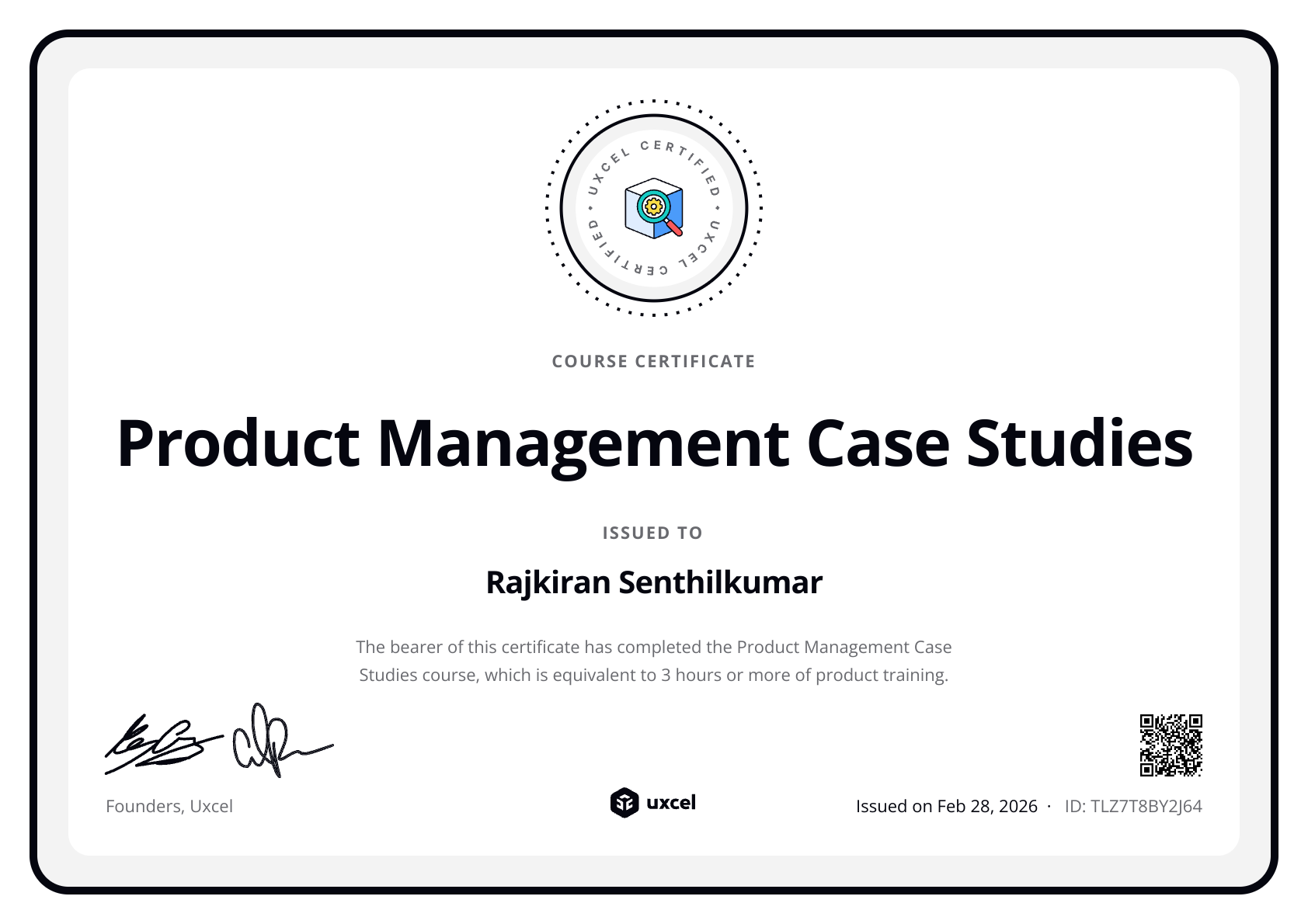
Certificate of completion
Product Management Case Studies
The bearer of this certificate has completed the Product Management Case Studies course, which is equivalent of 3 hours or more of professional training.



Explore popular courses

Introduction to Product Management


Product Analytics


Product Management for Designers

FAQs
Even outside hiring, case studies mirror the product challenges PMs face daily: unclear goals, ambiguous data, competing constraints, and pressure to make thoughtful decisions. Frameworks such as clarifying the problem, segmenting users, validating assumptions, or identifying root causes resemble diagnostic and discovery steps found in real workflows. Case studies also reinforce communication skills, which are one of the biggest predictors of PM effectiveness, because users learn to articulate reasoning, align stakeholders, and explain trade-offs with clarity. These habits directly support roadmap planning, feature evaluation, opportunity sizing, and cross-functional collaboration.
Users learn to approach any prompt with a clear structure: defining the goal, exploring user and market insights, identifying constraints, generating solution paths, prioritizing through impact and feasibility, and defining measurable outcomes. The course blends frameworks with practical examples, showing how PMs diagnose issues, design features, plan strategies, or analyze existing products. Users practice building strong narratives that reflect user-first thinking, data-informed reasoning, and business awareness. Those are the skills that are highlighted repeatedly in modern interview and case-study guidance.
Case-study thinking becomes a blueprint for tackling uncertain product situations. When engagement drops, onboarding slows, or a feature underperforms, PMs use the same reasoning patterns: clarify the problem, gather insights, evaluate options, choose a direction, define metrics, and communicate the path forward. These approaches help shape roadmaps, identify opportunities, justify prioritization decisions, build stakeholder alignment, and run effective discovery. Practicing case studies trains PMs to be clearer thinkers who make decisions with confidence and purpose.