The impact/effort matrix
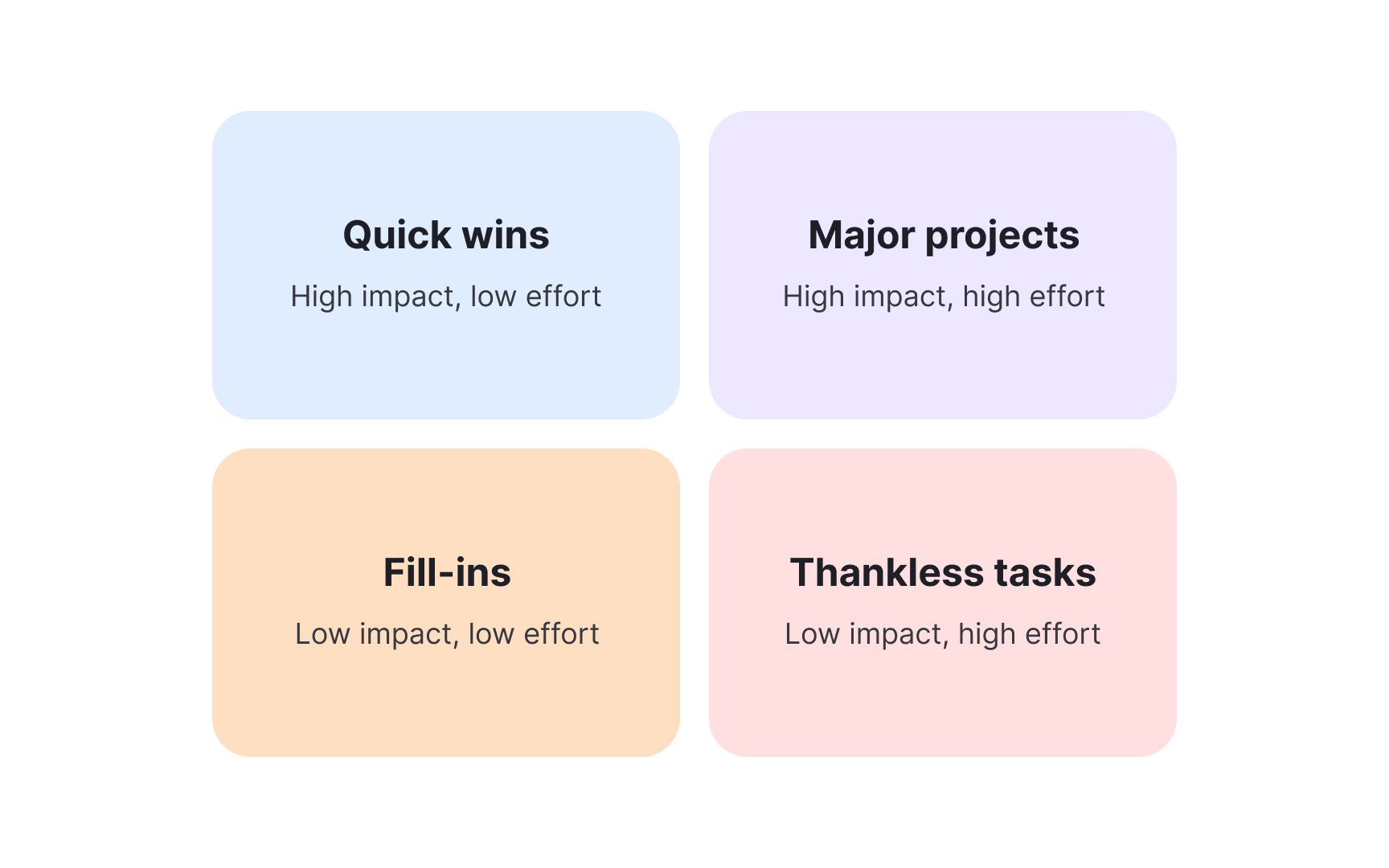
Impact/effort matrices help teams prioritize improvements by plotting them on two dimensions: the positive impact on customers and the effort required to implement. This visual tool prevents teams from pursuing complex solutions when simpler alternatives exist. It ensures resources focus on changes that deliver maximum value.
To create the matrix, draw 4 quadrants. The horizontal axis represents implementation effort (low to high), while the vertical axis shows customer impact (low to high). This creates 4 categories:
- Quick wins (high impact, low effort): Implement these immediately
- Major projects (high impact, high effort): Plan carefully and allocate sufficient resources
- Fill-ins (low impact, low effort): Consider for spare capacity
- Thankless tasks (low impact, high effort): Generally avoid these
Score each improvement idea from your journey map on both dimensions using consistent criteria. For impact, consider factors like customer satisfaction improvement, complaint reduction, or revenue potential. For effort, evaluate development time, cost, and complexity. Plot ideas on the matrix to visualize priorities.